
Three Separate Categories: Functional Mushrooms, Psilocybin, and Amanita Muscaria
When people search for mushrooms that help with anxiety, they are searching across three biologically and legally distinct categories that have very little in common. Conflating them leads to confusion about what is legal, what is studied, and what carries genuine risk. Understanding the distinction is the most useful starting point before any specific mushroom is discussed.
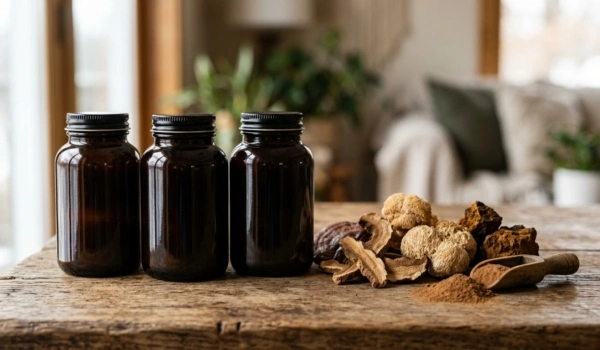
Functional mushrooms — including Reishi, Lion’s Mane, and Cordyceps — are adaptogenic species available as legal dietary supplements in most countries. They are not psychoactive. They work gradually through mechanisms such as cortisol modulation, neurotrophic support, and adrenal regulation. This is the category most relevant to anyone looking at supplements for daily stress and anxiety support.
Psilocybin mushrooms are a separate clinical research category entirely. They contain psilocybin, a controlled substance in most jurisdictions. Research into their effects on anxiety exists, but it takes place in supervised clinical or academic settings — not in a self-supplementation context. The findings from that research do not translate into general supplement advice.
Amanita muscaria is a third category that is frequently misrepresented online. It does not contain psilocybin. Its active compounds are muscimol and ibotenic acid, which act on GABA receptors. Amanita muscaria is not classified as a functional mushroom, is not a standard supplement, and carries distinct toxicity risks. The fact that it appears in some wellness marketing does not change its risk profile or make it comparable to Reishi or Lion’s Mane.
Functional Mushrooms with Anxiety Evidence: Reishi, Lion’s Mane, and Cordyceps
Reishi, Lion’s Mane, and Cordyceps are the three functional mushrooms most commonly studied in the context of stress and anxiety. Each works through a different mechanism, and the evidence behind each varies in type and strength. None should be described as a proven anxiety treatment, but each has a reasonable body of research context worth understanding.
Reishi
Reishi (Ganoderma lucidum) has the longest documented use context, with roots in Traditional Chinese Medicine where it was associated with calming effects and stress resilience. Its proposed mechanism for anxiety relevance involves cortisol regulation and support for adrenal function under chronic stress. Reishi has also been studied in relation to sleep quality, which is closely linked to anxiety management. According to a 2021 study referenced in supplementation literature, Reishi was associated with improved sleep quality and reduced anxiety markers in test subjects — though the study type, sample size, and peer-review status of this specific finding should be verified independently before drawing strong conclusions.
Lion’s Mane
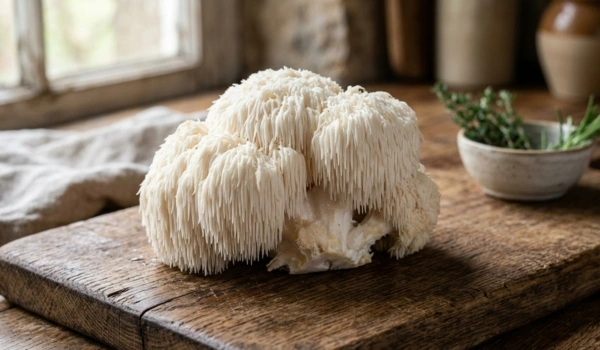
Lion’s Mane (Hericium erinaceus) is the functional mushroom most directly linked to neurological mechanisms relevant to mood and anxiety. Its primary proposed pathway involves stimulation of nerve growth factor (NGF) and brain-derived neurotrophic factor (BDNF), both of which play roles in neuroplasticity, mood regulation, and cognitive resilience. According to a cited 2010 human study, women who consumed Lion’s Mane over four weeks showed significantly reduced anxiety scores compared to placebo. This is one of the more directly relevant human studies in the functional mushroom space, though it is a single study and results should not be generalized broadly without replication. Lion’s Mane is often selected specifically for its neurotrophic support profile rather than general adaptogenic effects.
Cordyceps
Cordyceps is positioned primarily as an adaptogen that supports adrenal function and stress modulation rather than having direct neurotransmitter effects. Its relevance to anxiety is more indirect — through supporting the body’s physiological response to stress rather than targeting anxiety pathways specifically. Human research on Cordyceps for anxiety is less developed than for Reishi or Lion’s Mane, and most evidence comes from animal studies or research into athletic performance and fatigue reduction. Cordyceps is often included in functional mushroom blends for this adaptogenic stress-support role.
| Mushroom | Proposed Mechanism | Key Evidence Reference | Evidence Level Note | Typical Supplement Form | Caution Note |
|---|---|---|---|---|---|
| Reishi | Cortisol regulation, sleep quality support, adrenal modulation | 2021 study associated with improved sleep and reduced anxiety markers | Human study context; study type and peer-review status should be independently verified | Capsule, tincture, powder, functional tea | May interact with blood-thinning medications; consult a professional if on anticoagulants |
| Lion’s Mane | BDNF/NGF stimulation, neuroplasticity support, neurotransmitter environment | 2010 human study: reduced anxiety scores in women over four weeks | Single human study; promising but requires replication; some animal study support | Capsule, powder, extract | Some individuals report mild digestive sensitivity; check for mushroom allergies |
| Cordyceps | Adaptogenic adrenal support, stress-response modulation | Primarily animal studies and fatigue/performance research | Indirect anxiety evidence; human research on anxiety specifically is limited | Capsule, powder, functional beverage | Stimulating effect in some individuals; avoid combining with high caffeine intake |
How Functional Mushroom Supplements Work — and How Long They Take
Functional mushrooms do not work like acute anxiolytics. They are not sedatives, and they do not produce immediate calming effects. Their mechanism is gradual and systemic — supporting the biological systems that regulate how the body responds to stress over time, rather than suppressing anxiety in a single dose.
Consistency matters far more than dose loading. Most people who use functional mushroom supplements for anxiety-related purposes report noticing subtle changes — slightly better sleep, less physiological reactivity to stress, improved mood baseline — around the one-to-two-week mark of daily use. More noticeable or consistent shifts are typically reported after three to four weeks of daily supplementation. Single-dose use is unlikely to produce meaningful results and is not how these supplements are designed or studied.
Available supplement forms include capsules, powders, tinctures, and functional beverages such as mushroom coffee blends. Capsules are the most straightforward for consistency, since serving size is fixed. Powders offer flexibility but require attention to whether the product is a whole-mushroom powder or a concentrated extract — this distinction matters for the likely concentration of active compounds. Tinctures can be practical for people who prefer liquid formats, though alcohol-extracted and water-extracted tinctures may differ in which compounds are preserved.
One combination worth noting for sensitive individuals: Cordyceps has a mildly stimulating quality for some users. Combining Cordyceps-containing supplements with high caffeine intake may amplify restlessness or increase heart rate, which is counterproductive for anyone using these mushrooms specifically for anxiety support.
Anyone currently taking prescription medications — particularly blood pressure medications, immunosuppressants, or anticoagulants — or managing a chronic health condition, or who is pregnant or breastfeeding, should speak with a qualified healthcare professional before starting a functional mushroom supplement.
Psilocybin and Anxiety: What Clinical Research Actually Shows
Psilocybin research on anxiety is a legitimate and growing area of clinical science, but it is entirely separate from the functional mushroom supplement category. Psilocybin is a controlled substance in most jurisdictions, and the research that exists has been conducted in supervised clinical or academic settings with carefully screened participants — not in the context of self-supplementation or general wellness use.
The clearest documented application in anxiety research involves terminally ill patients experiencing existential distress and fear associated with end-of-life diagnoses. Studies conducted at institutions including Johns Hopkins and NYU have examined whether supervised psilocybin sessions can reduce anxiety and depression in this population. Results have been promising within that specific context, with some participants reporting sustained reductions in anxiety and improved quality of life following guided sessions.
What this research does not support is any generalized conclusion that psilocybin mushrooms are an appropriate self-treatment for everyday anxiety. The therapeutic setting, screening protocols, psychological support, and monitoring involved in these trials are a core part of the intervention — not incidental to it. The effects of psilocybin outside a controlled setting can include acute psychological distress, and the risk profile is meaningfully different from functional mushroom supplements.
Psilocybin remains illegal in most countries. In a small number of places, decriminalization or regulated therapeutic programs are emerging, but these are structured programs under clinical supervision. Anyone interested in this area of research is best directed toward following institutional developments rather than attempting self-directed use.
Amanita Muscaria: Mechanism, Risks, and Why It Is Not a Functional Mushroom
Amanita muscaria is not a functional mushroom, and it is not a safe or legal alternative to Reishi, Lion’s Mane, or Cordyceps. Some supplement marketing has attempted to position Amanita muscaria products as psychoactive wellness supplements, which misrepresents both its pharmacology and its risks.
The active compounds in Amanita muscaria are muscimol and ibotenic acid — neither of which is psilocybin. Muscimol acts as a GABA-A receptor agonist, producing sedative and dissociative effects that are chemically distinct from the serotonergic effects of psilocybin. Ibotenic acid is a neurotoxic compound that converts to muscimol through heat or dehydration, but this conversion is not reliably complete or predictable outside controlled laboratory conditions.
Muscimol has been studied for anxiolytic properties in laboratory settings because of its GABA receptor activity, but this pharmacological observation does not translate into a usable or safe supplement. The toxicity profile of Amanita muscaria is well documented. Symptoms of poisoning include confusion, hallucinations, nausea, excessive salivation, and in severe cases, more serious neurological effects. The margin between a dose that produces intended sedative effects and one that produces toxicity is not well characterized in human supplementation contexts.
Amanita muscaria products are not regulated as functional mushroom supplements, and no standardized safe serving has been established for human use. Amanita muscaria is not categorized as a functional mushroom by any regulatory or scientific body, and it should not be treated as one.
Choosing and Using Functional Mushroom Supplements for Anxiety Support
For anyone specifically interested in functional mushrooms as a supportive tool for stress and anxiety, the practical decisions come down to choosing the right species for your goal, evaluating product quality carefully, and setting realistic expectations about what these supplements can and cannot do.
Species selection should follow the evidence and mechanism. Lion’s Mane is the most directly relevant choice for people whose anxiety intersects with cognitive rumination, mood, or neurological resilience, given its BDNF-linked mechanism. Reishi is a reasonable option for people whose anxiety is connected to poor sleep, chronic stress load, or fatigue. Cordyceps fits best in a stress-support blend rather than as a standalone anxiety supplement.
Label evaluation matters more than brand recognition. Key things to check on any functional mushroom supplement label include:
- Extract vs. whole mushroom powder: Extracts are typically more concentrated in active compounds. A dual-extraction process — hot water plus alcohol — preserves both water-soluble beta-glucans and alcohol-soluble triterpenes, which is particularly relevant for Reishi.
- Beta-glucan content: Beta-glucans are the primary bioactive polysaccharides in functional mushrooms. Some quality products list beta-glucan percentage on the label; when listed, this gives a clearer sense of active compound concentration than weight alone.
- Third-party testing: Look for independent lab testing for heavy metals, pesticides, and identity verification. Mushroom products grown on grain substrates may contain starch fillers that dilute active content, and testing helps identify this.
- Fruiting body vs. mycelium on grain: Products made from mushroom fruiting bodies are generally considered to contain higher concentrations of beta-glucans than mycelium grown on grain, which may contain significant grain starch.
Functional mushrooms are supportive wellness tools — they are not replacements for clinical anxiety treatment, therapy, or medication where those are medically indicated. For people managing clinical anxiety disorders, functional mushroom supplements may be a useful complementary addition, but they should not substitute professional care. Anyone combining these supplements with prescription anxiolytics, antidepressants, or other medications should discuss this with their prescribing clinician before starting.
Used consistently, with quality products and realistic goals, functional mushrooms like Lion’s Mane and Reishi represent one of the better-evidenced categories in the broader supplement space for stress and anxiety support — not because the evidence meets pharmaceutical standards, but because the research direction is plausible, the safety profile is well established for most healthy adults, and the proposed mechanisms are biologically grounded.