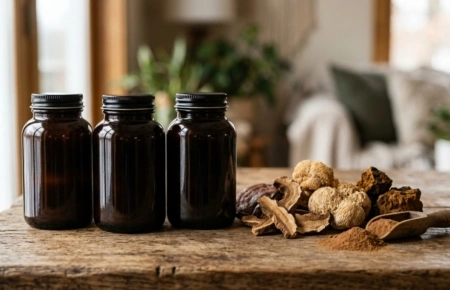
What Beta-Glucans Are and Why They Appear on Mushroom Supplement Labels
Beta-glucan percentage is the single most important quality number on a functional mushroom supplement label — more useful than total milligrams, serving size, or total polysaccharide claims. Beta-D-glucans are polysaccharides defined by a specific molecular architecture: in mushrooms, the biologically relevant structures share a (1→3),(1→6)-linked backbone that distinguishes them from the starches found in grain and other plant material. Because standardized, internationally recognized testing methods exist specifically for beta-D-glucans, beta-glucan percentage became the industry’s most meaningful potency marker. When this number appears on a label, it tells you how much of the supplement’s weight is composed of the compounds you are actually paying for.
This article covers only legal, non-psychedelic functional mushroom dietary supplements — such as lion’s mane, reishi, chaga, turkey tail, cordyceps, and maitake — and how to evaluate their labels as a consumer. Nothing here constitutes clinical dosing guidance or a recommendation to treat any health condition. Before beginning any supplement regimen, consult a qualified healthcare provider.
Beta-Glucans vs. Total Polysaccharides: Why the Distinction Matters
A total polysaccharide claim on a mushroom supplement label is not a reliable potency signal on its own. Polysaccharides include both beta-glucans — the mushroom-specific compounds you want — and alpha-glucans, the starches you do not. If a product is made from mycelium grown on grain, its total polysaccharide number will be inflated by residual grain starch. A label can truthfully state “40% polysaccharides” while containing almost no meaningful beta-glucan content.
The practical check is whether the label separately discloses beta-glucan content alongside a separate alpha-glucan figure. When a brand lists both, a high beta-glucan percentage combined with a low alpha-glucan percentage is a positive quality signal: it confirms the polysaccharide content comes from the mushroom, not from grain filler. If only a total polysaccharide figure appears with no breakdown, the number is functionally unverifiable and should not be treated as evidence of potency.
Fruiting Body vs. Mycelium-on-Grain: How Sourcing Shapes Beta-Glucan Percentage
Where a mushroom supplement comes from has a direct and measurable effect on how much beta-glucan it can realistically contain. Fruiting body extracts — made from the actual mushroom cap and stem — typically contain between 25% and 60% beta-glucans. Mycelium-on-grain products, in which fungal mycelium is grown on a substrate of rice, oats, or another grain and processed without separating the grain, often contain as little as 1% to 10% beta-glucans, with a large portion of the remaining weight being grain starch.
The label language that signals each sourcing approach is specific. Phrases like “mycelium biomass,” “myceliated grain,” or “full spectrum” without any clarification about grain removal almost always indicate a mycelium-on-grain product. Some brands use “full spectrum” to imply a more complete product, but without confirmation that the grain substrate has been removed and beta-glucan content separately verified, the term provides no quality assurance. By contrast, labels that state “fruiting body,” “fruiting body extract,” or a species name such as “Hericium erinaceus fruiting body” point to the higher-beta-glucan sourcing option. Knowing these phrases before you shop makes it possible to filter products at a glance.
How to Read the Supplement Facts Panel: Key Label Terms Decoded
The Supplement Facts panel is the most regulated part of a mushroom supplement label, but the terms it uses can still be confusing or misleading without context. Here is a term-by-term breakdown of what you will encounter.
Extract Ratio
An extract ratio such as “10:1” or “8:1” indicates how many units of raw mushroom material were used to produce one unit of extract. A 10:1 ratio means ten grams of raw mushroom became one gram of extract. Extract ratio says nothing about beta-glucan content. A concentrated extract of low-quality input material can still be low in beta-glucans. Extract ratio alone is not a substitute for a stated beta-glucan percentage.
Standardized To
“Standardized to X% polysaccharides” or “standardized to X% beta-glucans” indicates that the manufacturer has adjusted the extract so that every batch reaches a specific target percentage of the named compound. Standardization to beta-glucans is meaningful. Standardization to total polysaccharides is less useful — the number can include grain starch without disclosing it.
Proprietary Blend
A proprietary blend allows a brand to list several mushroom species under a single combined weight — for example, “Mushroom Complex Blend 800 mg” — without revealing how much of each species is included. This is legally permitted under DSHEA, the US dietary supplement regulatory framework. The practical risk: a proprietary blend can contain mostly inexpensive fillers with small, unstated amounts of the premium mushrooms named on the front of the label.
Full Spectrum
“Full spectrum” has no standardized regulatory definition in the mushroom supplement category. Some manufacturers use it to mean the product includes multiple compounds from the mushroom, including both fruiting body and mycelium. Others use it to describe an unprocessed whole-mushroom powder. Without accompanying beta-glucan disclosure and sourcing clarity, “full spectrum” is a marketing descriptor, not a quality guarantee.
Mycelium Biomass and Myceliated Grain
“Mycelium biomass” and “myceliated grain” are the terms that most directly signal a mycelium-on-grain product. These phrases appear in the ingredient list, not always in the marketing copy, so reading the full Supplement Facts panel — not just the front-of-label claims — is essential.
Under DSHEA, the FDA does not require manufacturers to disclose beta-glucan content, extraction method, extraction ratio, or third-party testing results on supplement labels. Every one of these disclosures is voluntary. A label that includes all of them is demonstrating transparency; a label that omits them is not necessarily hiding something illegal, but it gives you far less to evaluate.
What a Meaningful Beta-Glucan Percentage Actually Looks Like
The difference between a low and a high beta-glucan percentage translates directly into how much active compound you receive per serving. Consider a standard 500 mg capsule: at 15% beta-glucans, that capsule delivers 75 mg of beta-glucan. The same 500 mg capsule at 70% beta-glucans delivers 350 mg — nearly five times more active compound from an identical serving size, at what may appear to be a similar price on the shelf.
As a quality-comparison benchmark, fruiting body extracts in the 25% to 40% beta-glucan range are generally considered solid performers for consumer supplements, while some premium concentrated extracts reach 40% to 60% and above. Mycelium-on-grain products often fall below 10%. A beta-glucan percentage at or above 20% is commonly cited as a threshold that separates extracts worth considering from those that are mostly filler — but this is a label-quality comparison tool, not a clinical dosing target or a minimum effective dose for any health outcome. These benchmarks help you compare products; they do not prescribe how much beta-glucan your body needs.
How to Verify Label Claims: COAs, Megazyme Assay, and Third-Party Testing
A Certificate of Analysis (COA) is a document produced by a laboratory that independently tests a finished product or ingredient batch and reports measured values for specific compounds. For mushroom supplements, a COA that lists beta-glucan content is the most reliable tool for verifying whether the percentage stated on a label is accurate.
Not all COAs are equivalent. When evaluating one, look for these specific details:
- Beta-glucan listed separately from total polysaccharides. A COA that reports only “total polysaccharides” cannot confirm actual beta-glucan content.
- Megazyme assay named as the test method. The Megazyme beta-glucan assay is the accepted analytical standard for distinguishing beta-glucans from alpha-glucans in mushroom extracts. A COA that names this method specifically offers more confidence than one that simply states “polysaccharide testing.”
- An independent, third-party laboratory. In-house testing by the manufacturer has no external verification. Third-party labs have no financial incentive to overstate results.
- A recent test date. A COA from several years ago may not reflect current batches if production inputs or sourcing have changed.
Many reputable brands make COAs available on their websites or will provide them on request. If a brand cannot or will not supply a COA when asked, that absence is itself informative. Beta-glucan content should be measured by Megazyme assay rather than by generic polysaccharide methods, which can inadvertently count grain starch as part of the total. Voluntary disclosure does not guarantee accuracy; only independent lab verification can do that.
Red Flags and Quality Signals: A Side-by-Side Label Comparison
The table below consolidates the most actionable label signals into a direct comparison. Use it as a quick-reference checklist when evaluating any functional mushroom supplement.
| Label Element | Red Flag | Quality Signal |
|---|---|---|
| Sourcing language | “Mycelium biomass,” “myceliated grain,” or “full spectrum” with no grain-removal clarification | “Fruiting body” or “fruiting body extract” with species name confirmed |
| Polysaccharide claim | Only total polysaccharide percentage listed; no separate beta-glucan figure | Beta-glucan content listed separately from total polysaccharides |
| Alpha-glucan disclosure | No alpha-glucan figure; no way to assess starch content | Alpha-glucan percentage disclosed alongside beta-glucan; alpha-glucan is low |
| Beta-glucan percentage | Below 10%, or not stated at all | 20% or above for extracts; ideally 25–60% for fruiting body extracts |
| Extraction method | No extraction method mentioned; or “whole mushroom powder” with no extraction | Extraction method stated (e.g., hot water, dual extraction) and matched to target compounds |
| Blend transparency | Proprietary blend with multiple mushrooms under one combined weight; no individual amounts | Individual mushroom species and amounts listed separately |
| Third-party verification | No COA available; testing method not named; in-house testing only | Third-party COA available, Megazyme assay named, dated, and from an independent lab |
The four checks that separate a credible mushroom supplement label from a weak one are: fruiting body sourcing confirmed, beta-glucan content stated at 20% or above, an extraction method matched to the target compounds, and a third-party COA available on request. A label that passes all four is not a guarantee of any particular outcome — mushroom supplement research is ongoing and these are not clinical thresholds — but it is a meaningful sign that the brand is being transparent about what is actually in the product. A label that fails two or more of these checks gives you little basis for comparing potency and even less basis for confidence in the claims on the front of the package.