What Microdosing for Productivity Actually Means
Microdosing for productivity means taking a sub-perceptual dose of a psychedelic substance — typically around one-tenth to one-twentieth of a full psychoactive dose — on a repeating schedule, with the goal of gaining subtle improvements in focus, creativity, or cognitive output without triggering a hallucinogenic experience. Psilocybin and LSD are the two substances most commonly discussed in this context. The doses are intended to stay below the threshold of obvious perceptual effects, which is why the practice appeals to people seeking a cognitive edge in professional or creative settings.
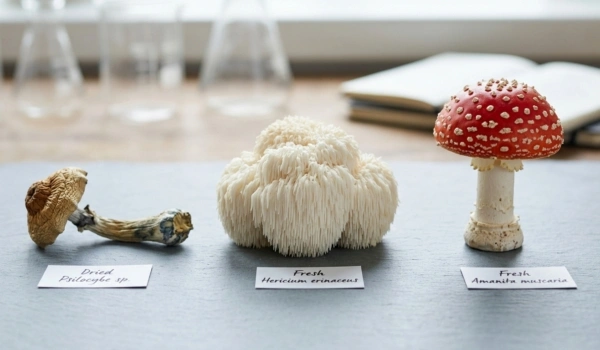
Psilocybin microdosing is entirely separate from taking functional mushroom supplements such as lion’s mane, reishi, or cordyceps. Functional mushrooms are legal dietary supplements with their own distinct evidence base. Psilocybin is a controlled psychedelic compound found in specific mushroom species. These two categories share no meaningful legal, pharmacological, or regulatory overlap.
What Self-Report and Observational Studies Found
Self-report and observational research consistently shows that people who microdose perceive meaningful improvements in focus, mood, creativity, and productivity — but these studies have a structural limitation that shapes how seriously those reports can be taken.
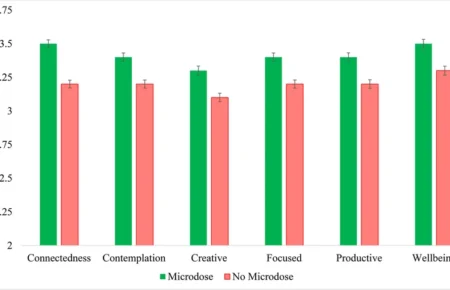
Across observational studies, participants reported benefits including improvements in attention, social cognition, mood, creativity, and general well-being. The pattern that emerges most clearly is timing-dependent: the perceived boost in connectedness, creativity, focus, happiness, and productiveness tends to be most pronounced on dosing days. That boost was mostly not maintained on the days that followed. There was some indication of a slight rebound in feelings of focus and productivity roughly two days after dosing, but the overall picture from observational data is a transient, same-day effect rather than a compounding or sustained cognitive uplift.
Longer-term microdosing, according to observational findings, was more associated with reduced mental distress and subtle shifts in absorption and attention than with measurable, sustained productivity gains. Users reported feeling more present or engaged, but dramatic productivity improvements are not consistently reflected even in self-report data over time.
The core methodological problem is the absence of placebo control. When people believe they are taking something that will improve their cognition, they often report exactly that — regardless of whether any pharmacological effect is responsible. All self-report microdosing research is highly susceptible to this expectancy effect, which means the data reflects what microdosers believe is happening, not necessarily what is.
What Controlled Clinical Trials Actually Showed
Randomized, double-blind, placebo-controlled trials have not consistently confirmed the productivity and cognitive benefits reported in observational research. This is the most important finding for anyone evaluating the popular narrative around psilocybin microdosing and LSD microdosing as cognitive tools.
In controlled studies, participants still reported feeling subjectively better — happier, more creative, more engaged. But when researchers used objective cognitive measurements rather than self-report, those subjective improvements did not translate into measurable gains. A controlled study examining low-dose psilocybin mushrooms found that while participants felt happier and more creative, there was no objective evidence of improvements in creativity, well-being, or cognitive function under blinded conditions.
Reporting on the state of psychedelic science, Harvard Health noted that evidence from recent studies on microdosing remains mixed — many people believe microdosing enhances mood, creativity, concentration, and productivity, but controlled research has not confirmed those benefits at the level popular claims suggest.
The gap between subjective experience and objective cognitive outcome is the central tension in microdosing research. It does not mean participants were exaggerating. It means the mechanism behind reported improvements may be expectancy — the placebo effect — rather than a direct pharmacological action on attention or creative cognition. That distinction matters for anyone making decisions about these substances.
The controlled trial findings challenge the framing of microdosing as a reliable productivity hack. The popular account — microdose, think better, produce more — has not been replicated under conditions that control for what the person believes they are taking.
Psilocybin vs. LSD for Focus and Creativity: Reported Differences
Psilocybin and LSD users who microdose describe the experience differently, and qualitative interview research has begun to map those reported distinctions — though these remain user-reported patterns, not confirmed pharmacological differences.
A qualitative study drawing on interviews with 41 users found a consistent experiential divergence between the two substances. Psilocybin microdosers more often described benefits that were relational and collaborative in character — feeling more connected to others, more empathic, better at communication in team settings. LSD microdosers more frequently linked their experience to individual focus and creative output — sharper attention on a specific task, faster ideation, more structured thinking.
| Substance | Reported User Experience Pattern | Primary Context Described | Evidence Type |
|---|---|---|---|
| Psilocybin | Relational, collaborative, emotionally connected | Teamwork, social settings, empathy | Qualitative interview data (41 users) |
| LSD | Individual focus, creative output, structured thinking | Solo work, ideation, concentrated tasks | Qualitative interview data (41 users) |
These patterns offer context for understanding why people choose one substance over the other. They are not clinical trial outcomes, do not establish that either substance reliably produces those effects, and should not be read as a comparison of safety or efficacy. The sample size is small, the methodology is qualitative, and individual variation is significant.
Legal Status, Safety, and Who Should Not Consider This
Psilocybin and LSD are controlled substances in most jurisdictions. In the United States both are classified as Schedule I, and microdosing them — regardless of stated purpose — is illegal in most countries. The claimed intent to use a substance for productivity does not alter its legal status, and possession or use carries serious legal consequences in most parts of the world.
Psychedelic substances carry specific risks that are not eliminated by sub-perceptual dosing. The group facing the most clearly elevated risk includes people with a personal or family history of psychosis, schizophrenia, or bipolar disorder. Psychedelic use — even at low doses — may precipitate or worsen psychotic episodes in vulnerable individuals. This is one of the most consistently cited safety signals in psychedelic research.
People taking psychiatric medications, including SSRIs, SNRIs, lithium, and MAOIs, face additional considerations around pharmacological interactions. Because most self-reported microdosing occurs outside any medical supervision, these interactions are rarely assessed or monitored. Individuals managing mental health conditions with medication should not self-experiment with psychedelic substances.
The absence of medical supervision in most real-world microdosing means there is no clinical oversight of dose accuracy, psychological state, or response over time. The substances involved are not pharmaceutical-grade products in most cases, and users cannot verify purity or consistency.
For anyone experiencing cognitive difficulties, attention problems, burnout, or low mood, the more appropriate starting point is a conversation with a qualified healthcare professional. The appeal of microdosing for productivity is understandable given how widely it is discussed, but controlled evidence does not yet support the popular narrative — and the legal and safety risks are real regardless of how the practice is framed.