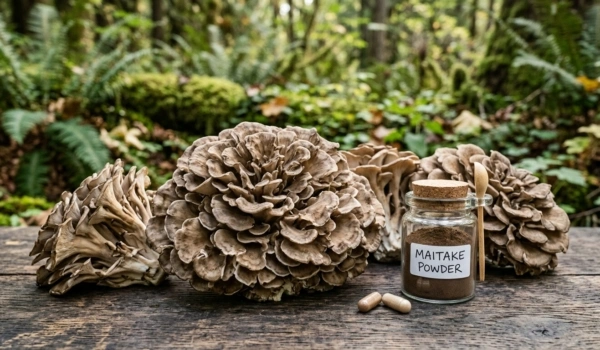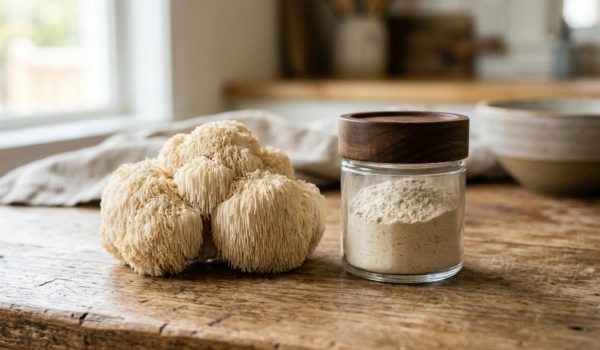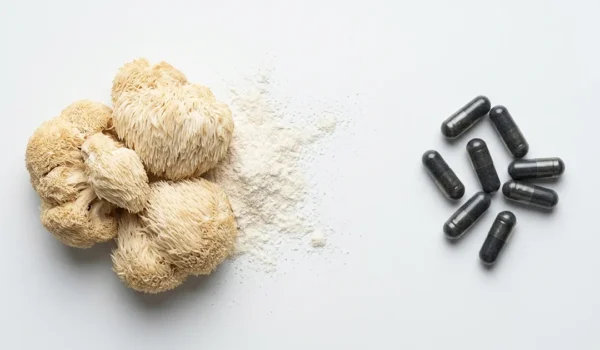
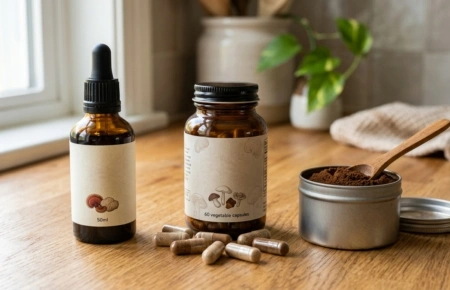
Capsules, powder, and tincture are all valid functional mushroom supplement formats — but which one works best depends less on the container and more on what’s inside it. The format you choose is primarily a lifestyle and convenience decision. The quality decision happens earlier, when you check the extraction method and source material on the label. This article covers how each format works, what drives potency across all three, and how to pick the one that fits your routine.
This article covers functional mushroom supplements only — lion’s mane, reishi, chaga, cordyceps, turkey tail, and similar species. It does not address psilocybin mushrooms, Amanita muscaria, or any psychedelic or controlled substance.
What Each Format Actually Contains
Mushroom capsules, powders, and tinctures are delivery formats — not independent product categories. What matters is the substance filling that format, and this is where products diverge significantly.
Capsules are pre-measured doses in a dissolvable shell. Their potency depends entirely on what the capsule contains. A capsule filled with dried, ground whole mushroom delivers far fewer bioactive compounds than one filled with a standardized dual-extract powder. The capsule itself is neutral — it doesn’t upgrade or degrade the material inside.
Powders sold as mushroom supplements fall into two distinct categories. Whole-mushroom powder is simply dried and ground fruiting body or mycelium. Extract powder has gone through an extraction process — typically hot water, alcohol, or both — that breaks down the chitin cell walls and concentrates the bioactive compounds. Extract powder and whole-mushroom powder are not the same product, even though both are sold as “mushroom powder.”
Tinctures are liquid extracts. A well-made mushroom tincture uses dual extraction: hot water to pull out water-soluble beta-glucans and polysaccharides, then alcohol to capture alcohol-soluble compounds like triterpenes. This dual-extraction approach is why reishi and chaga tinctures are often specifically sought — triterpenes, which are abundant in those species, require alcohol for extraction and would be absent in a water-only product.
One content quality concern applies across all formats: products made from mycelium grown on grain substrate may contain significant grain starch filler. This dilutes the concentration of active compounds regardless of whether the end product is sold as a capsule, powder, or tincture. Checking whether a product discloses its source material — and whether it states the beta-glucan percentage — is more useful than choosing a format based on appearance alone.
Absorption and Onset: What the Science Supports
How quickly and efficiently a functional mushroom supplement works depends on both the delivery route and the specific compounds involved — and these two factors interact in ways that marketing language tends to oversimplify.
Tinctures taken sublingually — held under the tongue before swallowing — are often described as fast-acting, with reported onset around 15 to 30 minutes. The mechanism behind this is real for some compounds: small, lipophilic molecules like triterpenes can be absorbed directly through the mucous membranes under the tongue, bypassing first-pass liver metabolism. This is why reishi tinctures in particular are sometimes preferred by users who want triterpene content delivered quickly.
However, the sublingual route has a meaningful limitation for mushroom supplements. Beta-glucans — the large polysaccharide compounds associated with immune support in species like turkey tail and lion’s mane — are too large for efficient sublingual absorption. Beta-glucans in tinctures are primarily absorbed through the gut after swallowing, the same route capsules and powders use. The speed advantage of tinctures is therefore compound-specific, not universal.
Capsules take longer to act because the shell must dissolve before the contents are released in the digestive tract. The exact timing depends on capsule material, individual digestion, and whether the capsule is taken with food. This is a practical difference in onset, not a potency difference.
Extract powders — whether taken loose or encapsulated — are meaningfully more bioavailable than simple dried-and-ground whole-mushroom powders. The chitin in fungal cell walls resists human digestion, so unextracted powders release fewer active compounds. The extraction process does the cell-wall breakdown work in advance, making the compounds more accessible during digestion.
Direct comparative pharmacokinetic data across formats in human studies is limited. Absorption claims in this area are generally mechanistic reasoning rather than controlled clinical outcomes, so treating any onset figure as a guaranteed benchmark is not supported by current evidence.
Why Extraction Method Matters More Than the Format You Choose
The most important quality decision when buying a functional mushroom supplement is not whether to choose capsules, powder, or tincture — it is what extraction process was used and where the mushroom material came from.
A capsule containing dual-extracted fruiting body powder from lion’s mane will deliver more bioactive compounds than a tincture made with a single alcohol pass through mycelium-on-grain material. The format comparison is almost irrelevant when the underlying product quality differs this much. This is the core principle that cuts through most mushroom supplement marketing.
Hot-water extraction breaks down chitin cell walls and concentrates polysaccharides including beta-glucans. Alcohol extraction captures triterpenes and other lipophilic compounds that water cannot dissolve. A dual-extraction process — combining both — yields the broadest compound profile. A single-method extract will always be incomplete for species like reishi and chaga where both compound classes are considered relevant.
Source material matters equally. Fruiting bodies — the visible part of the mushroom above the substrate — tend to have higher concentrations of the compounds researchers have studied. Mycelium-based products are not inherently inferior, but mycelium grown on grain substrate can retain significant quantities of grain starch in the final product. Some manufacturers of mycelium-based supplements do test and disclose their beta-glucan content, which is the most direct way to verify that grain starch is not crowding out the active compounds. A product that discloses a verified beta-glucan percentage is more transparent than one that lists only total polysaccharides, since starch is also technically a polysaccharide and would inflate that number.
Before comparing formats, check the label for three things — source (fruiting body or mycelium), extraction method, and a stated beta-glucan percentage. A well-labeled capsule or powder that passes this check will outperform a poorly labeled tincture, and vice versa.
Format Comparison at a Glance: Convenience, Potency, and Taste
With extraction quality as the baseline, format differences come down to how you want to take your supplement daily. The table below summarizes practical trade-offs across the three formats.
| Format | Onset | Taste | Best Use Case | Key Label Check | Practical Caution |
|---|---|---|---|---|---|
| Capsules | Slower — shell must dissolve first | None | Daily routine, travel, dose consistency | Extract type, fruiting body or mycelium, beta-glucan % | Check fill: whole powder vs. extract powder |
| Powder (extract) | Moderate — absorbed through gut | Earthy, varies by species | Mixing into food, drinks, smoothies, coffee | Confirm extract powder, not just dried mushroom; beta-glucan % | Whole-mushroom powder is less bioavailable than extract powder |
| Tincture | Faster sublingually for small molecules (triterpenes) | Strong — bitter or alcohol taste | Dual-compound extraction, reishi/chaga triterpene content, dose ritual | Dual extraction stated, beta-glucan content, alcohol percentage | Beta-glucans are not efficiently absorbed sublingually — gut absorption still applies |
Capsules are the lowest-friction format for daily use. There is no taste to manage, no preparation step, and the dose is pre-measured. For someone who wants to take lion’s mane or cordyceps consistently without thinking about it, capsules containing a verified extract powder are a practical choice. The trade-off is that you cannot adjust the serving size without opening the capsule.
Extract powders work well for people who already blend drinks, make morning coffee, or cook in ways where adding a half-teaspoon of powder is natural. The versatility is real, but it requires a bit more daily friction than capsules. The key distinction to look for on the label is whether the powder is an extract powder or simply dried-and-ground mushroom — they differ significantly in how bioavailable their compounds are.
Tinctures are best suited to users who specifically want both beta-glucan and triterpene content from a single product, particularly for reishi or chaga. The taste is strong and not for everyone. For someone who wants the dual-extraction compound profile without the flavor, a capsule containing dual-extract powder achieves a similar result, though without the sublingual delivery route for triterpenes.
How to Choose Your Format: A Practical Decision Guide
Format choice for functional mushroom supplements is a lifestyle decision — once you’ve confirmed the extraction quality, the right format is the one you’ll actually use consistently.
- If consistency and simplicity matter most — capsules are the practical choice. Pre-measured, portable, tasteless. Look for capsules that state fruiting body source, extraction method, and beta-glucan percentage on the label.
- If you mix supplements into food or drinks — extract powder fits naturally. It integrates into smoothies, coffee, soups, or oatmeal without changing the routine much. Confirm it is extract powder, not whole-mushroom powder, by checking the label for extraction method and beta-glucan content.
- If you want both beta-glucans and triterpenes — and don’t mind the taste — a dual-extraction tincture is a logical format for reishi or chaga specifically. Check that the label explicitly states dual extraction (water and alcohol) and discloses beta-glucan content.
- If you want a broad compound profile without the taste of tinctures — dual-extract capsules or extract powders that have gone through both hot-water and alcohol extraction steps achieve a similar compound range in a more palatable form.
Regardless of format, three label checks matter for any functional mushroom supplement:
- Source: fruiting body or mycelium — and if mycelium, whether grain content or beta-glucan percentage is disclosed
- Extraction method: hot water, alcohol, or dual — absence of this information on the label is a transparency concern
- Beta-glucan percentage: a stated and verified figure is the most direct measure of active compound concentration across all three formats
If any of these three pieces of information are absent from the label, the product is harder to evaluate regardless of its format or price point.
Anyone taking prescription medications, managing a chronic health condition, or who is pregnant, breastfeeding, or preparing for surgery should check with a qualified healthcare professional before adding any mushroom supplement to their routine. Interactions between mushroom compounds and certain medications — particularly immunosuppressants and anticoagulants — have been noted in clinical literature and are worth discussing with a professional who knows your full health picture.
Frequently Asked Questions
Can I switch between formats without losing consistency?
Yes, as long as the extraction quality is comparable across products. If you switch from an extract powder to a capsule product, check that both list the same source, extraction method, and a similar beta-glucan percentage. The format itself does not determine whether the transition is consistent — the compound profile does.
Is a tincture automatically stronger than capsules?
No. A tincture made with a single alcohol extraction from mycelium-on-grain material will likely contain fewer relevant bioactive compounds than a capsule filled with dual-extracted fruiting body powder. Strength is a function of extraction quality and source, not format.
What does “dual extraction” actually mean on a tincture label?
Dual extraction means the product was processed with both hot water — to extract water-soluble beta-glucans and polysaccharides — and alcohol, to extract alcohol-soluble triterpenes and other lipophilic compounds. A single-method tincture using alcohol only will contain triterpenes but minimal beta-glucans. A hot-water-only tincture will contain beta-glucans but few triterpenes. For reishi or chaga, dual extraction is the more complete option if you want both compound classes.
Does the serving size differ by format?
Serving sizes vary by product and are not standardized across formats or brands. Follow the guidance on the specific product label rather than applying a single benchmark across formats. If the label does not state the beta-glucan content or the extract ratio, the serving size figure alone does not tell you how much active compound you are actually taking.