What Is Chaga Mushroom?
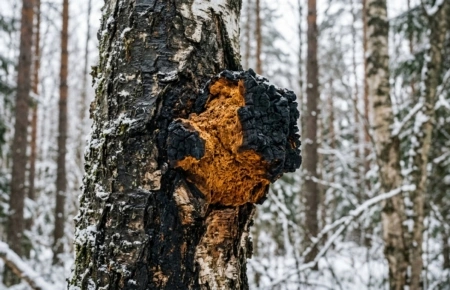
Chaga mushroom (Inonotus obliquus) is a functional, non-psychedelic mushroom that grows on birch trees in cold northern climates, including Siberia, Canada, and Scandinavia. It is not related to psilocybin mushrooms or any controlled substance — chaga belongs firmly in the category of functional mushrooms used as dietary supplements. Folk medicine records in Russia and Northern Europe document its use as far back as the 16th century, primarily for gastrointestinal complaints, diabetes, and liver conditions. Modern interest in Inonotus obliquus health effects has grown alongside preclinical research into its bioactive compounds.
Chaga does not look like a typical mushroom cap. It appears as a dark, irregular mass protruding from birch bark, with a rust-orange interior. The dark outer crust is rich in melanin — one of the compounds now studied for antioxidant properties. The hardened sclerotium that grows on the tree is harvested, dried, and processed into the supplement forms sold today.
Key Bioactive Compounds in Chaga and What They Do
Chaga’s studied effects trace back to four main groups of bioactive compounds: polysaccharides (including beta-glucans), triterpenoids, polyphenols, and melanins. Each has a distinct mechanism studied in laboratory and animal research, and understanding which compound does what helps separate genuine research findings from vague marketing language.
Polysaccharides and Beta-Glucans
Beta-glucans are naturally occurring carbohydrates found in chaga’s cell walls. In preclinical research, they are associated with immune modulation — specifically, they appear to interact with receptors on immune cells in ways that promote cytokine signaling and white blood cell activity. Beta-glucans are the most studied functional compound across multiple mushroom species, and chaga contains meaningful quantities. This immune-stimulating mechanism is why chaga extracts are often positioned for immune support, though human clinical evidence remains limited.
Triterpenoids
Triterpenoids, including betulinic acid and inotodiol, are fat-soluble compounds found in chaga. In laboratory studies, these compounds have shown anti-inflammatory activity by modulating certain inflammatory signaling pathways. Some triterpenoids have also been studied for anticancer properties in cell culture models, where they appear to influence tumor cell behavior. These are preclinical findings and do not translate into treatment claims for humans.
Polyphenols
Chaga contains a range of polyphenols, which function primarily as antioxidants. In test-tube studies, chaga polyphenol extracts have shown capacity to neutralize reactive oxygen species. This antioxidant activity is one of the most consistently observed properties in Inonotus obliquus research, and it may underpin several other studied effects, including anti-inflammatory and hepatoprotective activity.
Melanins
The dark exterior of chaga is composed largely of melanin pigments — a relatively unusual feature in mushrooms. Chaga melanins have been studied for antioxidant and potential radioprotective properties in animal models, and are also linked to observed anti-fatigue effects in some animal studies. As with the other compounds, translation of these findings to human health outcomes requires further clinical investigation.
A 2024 review published in PMC summarizes that Inonotus obliquus extracts demonstrate anti-inflammatory, antioxidant, anticancer, anti-diabetic, anti-obesity, hepatoprotective, renoprotective, anti-fatigue, antibacterial, and antiviral activities across experimental models — a wide profile that reflects the chemical complexity of the mushroom rather than a single mechanism.
Main Health Benefits of Chaga: What the Evidence Shows
The majority of evidence for chaga’s studied benefits comes from animal and in vitro (test-tube) studies, not human clinical trials. Preclinical findings identify plausible mechanisms worth investigating, but none of the effects below should be treated as established health claims for people. Each benefit area is marked by its evidence level.
| Studied Effect | Study Type | Evidence Level | Key Caution |
|---|---|---|---|
| Antioxidant activity | In vitro (test-tube) | Preclinical only | Free radical scavenging in lab conditions does not confirm human antioxidant benefit |
| Immune modulation | Animal and in vitro | Preclinical only | Immune stimulation may be problematic for people with autoimmune conditions |
| Anti-inflammatory effects | Animal and in vitro | Preclinical only | Mechanism identified in lab models; no confirmed human dose or protocol |
| Cholesterol and lipid support | Animal studies | Preclinical only | Observed LDL reduction and HDL increase in animal models; human trials lacking |
| Blood sugar effects | Animal studies | Preclinical only | May interact with diabetes medications; risk of combined blood sugar lowering |
| Liver protection (hepatoprotective) | Animal and in vitro | Preclinical only | No human clinical evidence; high-dose use poses its own liver and kidney risk |
Antioxidant Activity
Chaga extracts consistently show high antioxidant capacity in test-tube assays, largely attributed to polyphenols and melanins. This is one of the best-documented properties of Inonotus obliquus at the laboratory level. Whether this translates into a meaningful antioxidant effect in the human body — where bioavailability, metabolism, and dosing all matter — has not been established in controlled human trials.
Immune Function
Animal and cell-based studies suggest chaga extract may promote the production of beneficial cytokines and stimulate white blood cell activity, consistent with the beta-glucan mechanism described above. Some animal studies have shown promising results for immune defense and for slowing tumor growth in cancer models, as noted in Healthline’s expert-reviewed overview of chaga. Human clinical trials confirming these immune effects are still needed.
Cholesterol and Blood Sugar
Animal studies have observed that chaga extract may reduce LDL cholesterol and triglycerides while increasing HDL cholesterol and antioxidant markers. Separately, anti-diabetic activity — including blood sugar lowering — has been observed in animal models. Both effects carry interaction risk: people taking cholesterol medications or diabetes drugs should be aware that chaga may compound those effects in unpredictable ways.
Anti-Inflammatory and Liver Protection
Triterpenoids and polyphenols in chaga have shown anti-inflammatory activity in lab models, and hepatoprotective effects have been documented in animal studies. These findings appear across multiple experimental contexts, which is why chaga is often marketed toward liver and inflammation support. The gap between animal model results and human clinical benefit remains significant, and none of these effects constitute a treatment recommendation.
Chaga Supplement Forms and How People Use Chaga
Chaga is sold as a legal dietary supplement in most markets and is available in several practical forms. The form affects the likely concentration of active compounds, convenience, and cost — so understanding label differences is more useful than defaulting to one format.
| Form | How It Is Typically Used | What to Check on the Label | Practical Note |
|---|---|---|---|
| Tea / chunks | Simmered in hot water for 15–20 minutes; traditional preparation method | Whether it is raw chaga or processed; no standardization indicated | Lower concentration of actives compared to extracted products; common for routine use |
| Powder | Mixed into hot water, coffee, or smoothies | Whether it is a whole powder or an extract; if extract, ratio or beta-glucan percentage | Whole powder and extract powder are different products — check the label carefully |
| Extract | Added to liquids; concentrated form | Extraction method (hot water, dual extraction), extract ratio (e.g., 10:1), polysaccharide content | Hot-water extraction is standard for beta-glucans; dual extraction may also capture triterpenoids |
| Capsules | Taken with water; convenient daily format | Whether contents are extract or whole powder; serving size; added ingredients | Easiest format for consistency; check for fillers or allergens |
| Tincture | Liquid drops added to drinks | Alcohol vs. glycerin base; extraction source; concentration | Alcohol-based tinctures may extract different compound profiles than water-based products |
Serving sizes vary widely between products, and labels rarely align with the amounts used in preclinical research. No health authority has established a recommended daily intake for chaga, so the label’s suggested serving is the practical reference point. Anyone taking medications, managing a chronic health condition, or who is pregnant, breastfeeding, or preparing for surgery should speak with a qualified healthcare professional before starting a chaga supplement.
Safety, Side Effects, and Drug Interactions
Chaga is not automatically safe because it is a natural functional mushroom. Several documented safety concerns apply specifically to chaga, and some are serious enough to be relevant even for otherwise healthy people considering regular use.
Kidney Risk from High Oxalate Content
Chaga contains very high levels of oxalates — compounds that can accumulate in the kidneys and form crystals when consumed in significant quantities over time. This is not a theoretical concern: published case reports document oxalate nephropathy directly linked to chaga consumption, and at least one case of end-stage renal disease has been reported following high-dose or prolonged chaga use. People with a history of kidney stones, kidney disease, or reduced kidney function face meaningful risk from regular chaga supplementation. Even in otherwise healthy individuals, very high or sustained intake carries documented hazard.
Interactions with Blood Thinners
Chaga contains a protein that can inhibit blood clotting. This creates a direct interaction risk with anticoagulant medications such as warfarin and other blood-thinning drugs. Taking chaga alongside anticoagulants may increase bleeding risk in an unpredictable way. The same concern applies to people with clotting disorders or those scheduled for surgery — chaga should be discontinued well before any surgical procedure, and anyone on anticoagulants should not start chaga without medical guidance.
Interactions with Diabetes Medications
Animal studies have shown that chaga can lower blood sugar levels. For someone already taking insulin or oral diabetes medications, adding chaga may compound blood sugar lowering to a degree that causes hypoglycemia. This is a specific, named interaction. Anyone managing blood sugar with medication should treat chaga supplementation as a pharmacological variable that requires professional oversight, as WebMD’s medically reviewed profile of chaga also flags explicitly.
Autoimmune Conditions
Because chaga stimulates immune activity through beta-glucan and cytokine pathways, it may worsen conditions where the immune system is already overactive — including rheumatoid arthritis, lupus, and multiple sclerosis. People using immunosuppressant medications for these conditions face a compounding concern: the immune stimulation from chaga may work against the medication’s purpose.
Pregnancy, Breastfeeding, and Children
There is no reliable safety data for chaga use during pregnancy or breastfeeding. Given the documented effects on immune function, blood clotting, and blood sugar, and the absence of human trial data, chaga is not appropriate during pregnancy or while breastfeeding without explicit medical clearance. Safety data for children is similarly lacking.
Who Should Be Careful with Chaga
Some people face meaningfully higher risk from chaga supplementation than the general population. This reflects the compound-level and interaction-level concerns described above, not a standard disclaimer.
People with kidney disease or a history of kidney stones should approach chaga with particular caution. The oxalate content is high enough to have caused documented nephropathy cases, and existing kidney impairment raises that risk substantially.
Anyone taking anticoagulants or blood-thinning medications — including warfarin, heparin, or newer anticoagulants — should not add chaga without talking to the prescribing physician. The bleeding risk is specific and named, not speculative.
People with autoimmune conditions, especially those using immunosuppressant drugs, face a conflict between chaga’s immune-stimulating mechanism and the purpose of their medication.
People with diabetes who are managing blood sugar with insulin or oral medications need to account for chaga’s documented blood sugar lowering effect, which may amplify their medication’s action.
Anyone preparing for surgery should stop chaga well in advance, given its effect on blood clotting. Specific timing should be confirmed with the surgical team.
Pregnant and breastfeeding individuals should avoid chaga until adequate safety evidence exists, which it currently does not.
Chaga’s compound profile makes it genuinely interesting from a research perspective, and preclinical findings across antioxidant, immune, and anti-inflammatory pathways are well-documented. The same biological activity that makes chaga worth studying also means it has real physiological effects and real interactions. If any of the groups above apply to you, speaking with a doctor or pharmacist before starting chaga is the step that matters most.