
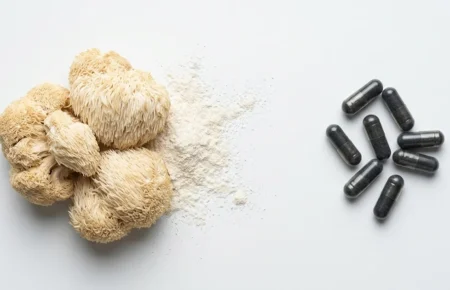
What Is a Nootropic Mushroom Stack?
A nootropic mushroom stack is a purposeful combination of functional mushroom extracts chosen to support brain health, mental clarity, memory, and focus simultaneously. Rather than taking a single species, stacking pairs mushrooms whose bioactive compounds act on different biological pathways — so the combined approach targets more than any one mushroom could alone. The key bioactives involved include hericenones and erinacines from Lion’s Mane, beta-glucans and triterpenes from Reishi, and cordycepin from Cordyceps, each interacting with distinct mechanisms related to cognition and stress response.
Functional mushrooms used in nootropic stacks — species like Hericium erinaceus (Lion’s Mane), Ganoderma lucidum (Reishi), and Cordyceps militaris — are dietary supplements, not the same as psilocybin-containing mushrooms or Amanita muscaria. They are legally sold as food supplements in most countries and contain no psychoactive compounds.
The rationale for stacking is complementary coverage across different cognitive targets: one mushroom may support nerve regeneration pathways, another may improve oxygen utilization for mental energy, and a third may reduce stress-driven cognitive interference. Whether those effects combine in a clinically meaningful way in humans is still being studied, but the framework drives most commercially designed mushroom cognitive stacks.
Key Mushrooms for Focus and Their Bioactive Roles
The three most commonly referenced mushrooms in a foundational focus stack are Lion’s Mane, Cordyceps, and Reishi — each contributing a distinct biological role tied to identifiable bioactive compounds.
Lion’s Mane (Hericium erinaceus) is the cognitive centerpiece of most stacks. Its fruiting body contains hericenones, and its mycelium contains erinacines — both classes of compounds associated with stimulating Nerve Growth Factor (NGF) production and supporting Brain-Derived Neurotrophic Factor (BDNF) levels. These proteins are critical for neuroplasticity, the maintenance of existing neurons, and the growth of new nerve connections. Lion’s Mane is the primary reason mushroom stacks are discussed in the context of focus and memory support.
Cordyceps contributes primarily through cordycepin and adenosine-related compounds linked to cellular energy production via ATP pathways. In stack literature, Cordyceps is positioned as the energy component — supporting mental stamina and reducing fatigue rather than directly influencing neurotrophic factors.
Reishi brings a different mechanism: its triterpenes and beta-glucans are associated with modulating the stress response and supporting immune function. In a cognitive stack, Reishi is typically valued for reducing stress-related mental interference that undermines focus — acting as the calming, stabilizing layer.
| Mushroom | Primary Role in Stack | Key Bioactive Compounds | Source in Mushroom |
|---|---|---|---|
| Lion’s Mane (Hericium erinaceus) | Focus, neuroprotection, NGF/BDNF support | Hericenones, erinacines | Hericenones: fruiting body; Erinacines: mycelium |
| Cordyceps (C. militaris) | Energy, mental stamina, fatigue reduction | Cordycepin, adenosine analogues | Fruiting body and mycelium |
| Reishi (Ganoderma lucidum) | Stress modulation, calm focus, immune support | Triterpenes, beta-glucans | Fruiting body (triterpenes primarily in outer layer) |
Extraction method affects which compounds survive processing. A hot-water extract preserves beta-glucans well. An alcohol extract is better suited for fat-soluble compounds like triterpenes. A dual-extract — combining both methods — is often referenced as the most complete option for mushrooms like Lion’s Mane and Reishi where access to both compound classes is the goal. A single-extraction product is not without value, but extraction type is a meaningful label-reading point when comparing products.
Lion’s Mane for ADHD and Brain Fog: What the Evidence Actually Shows
Lion’s Mane is frequently discussed in the context of ADHD and brain fog, but the honest picture is more nuanced than most supplement marketing suggests. No published clinical trials have specifically tested Lion’s Mane as a treatment for ADHD. What does exist is a plausible biological mechanism and a growing body of early-stage research on cognitive support — and those two things are worth distinguishing carefully.
The mechanism that generates the most discussion is NGF stimulation. Hericenones and erinacines have been shown in cell and animal studies to promote the synthesis of Nerve Growth Factor, a protein that supports the survival, maintenance, and regeneration of neurons. Lion’s Mane is also associated with supporting BDNF (Brain-Derived Neurotrophic Factor), which plays a role in neuroplasticity — the brain’s ability to adapt, form new connections, and recover from stress. Both NGF and BDNF are considered relevant to cognitive resilience and mental clarity.
People searching for Lion’s Mane in relation to ADHD are often looking for ways to support attention and reduce cognitive fog without pharmaceutical intervention. The NGF and BDNF pathways are genuinely relevant to focus and mental clarity — not as a cure or a direct treatment mechanism for ADHD, but as pathways that support healthy neurological function more broadly. That distinction matters.
Brain fog — the experience of mental fatigue, slow thinking, and difficulty concentrating — is not a diagnosis, and its causes vary widely. Lion’s Mane may support the neurological environment in ways that some people find helpful for mental clarity, but this is not equivalent to a clinical intervention. Human trials on Lion’s Mane have explored mood, mild cognitive impairment, and general cognitive function with some positive findings, but an evidence base for ADHD specifically does not yet exist.
Lion’s Mane is not an ADHD treatment and should not be used as a substitute for medical evaluation or established care. If ADHD or significant cognitive difficulty is affecting daily functioning, a qualified healthcare provider is the appropriate starting point.
Adaptogens vs. Nootropics: Where Functional Mushrooms Fit
Functional mushrooms can legitimately belong to both the adaptogen and nootropic categories — and understanding the difference between those categories helps explain why a mushroom stack can target stress and focus at the same time.
Adaptogens are broadly defined as substances that help the body modulate its response to stress — physical, mental, or environmental. They work systemically, not just on cognition. Reishi and Cordyceps are both commonly classified as adaptogens because their primary effects relate to stress response, immune modulation, and overall physiological balance rather than targeting a specific cognitive pathway.
Nootropics are specifically associated with cognitive performance: memory, focus, processing speed, mental fatigue reduction, and neuroplasticity. Lion’s Mane fits most clearly here, given its NGF and BDNF associations. The categories are not mutually exclusive — Cordyceps, for example, is both adaptogenic (systemic stress support) and nootropic-adjacent (energy and mental stamina).
This overlap is practically useful. A Lion’s Mane, Cordyceps, and Reishi stack is not just three similar things taken together — it combines a direct cognitive-support compound (Lion’s Mane), an energy-and-stamina compound (Cordyceps), and a stress-buffer compound (Reishi). The stress-buffer role matters because chronic stress directly impairs cognitive performance; reducing that interference is a legitimate route to clearer thinking.
Beyond mushrooms, Lion’s Mane is commonly stacked with non-mushroom nootropics to extend the cognitive support profile. Bacopa Monnieri is often added for memory consolidation support. Rhodiola Rosea — itself an adaptogen — is used for mental fatigue and stress resilience. Omega-3 fatty acids and Citicoline are referenced as foundations for brain structure and acetylcholine support, respectively. These combinations are not clinically validated as superior to individual supplements, but they reflect how practitioners and supplement formulators approach building a more complete cognitive stack.
These are functional categories used in wellness and supplement literature, not regulatory or clinical definitions. Classifying something as an adaptogen or nootropic does not constitute a drug claim or a clinical finding.
How to Take a Mushroom Stack: Forms, Serving Guidance, and Timing
Mushroom stacks are available in several forms, and the choice affects both convenience and which bioactive compounds are present in meaningful amounts.
Capsules are the most common and practical format — pre-measured, easy to take consistently, and straightforward to compare by serving size. Powders offer flexibility for adding to drinks or food but require more attention to measuring. Liquid extracts and tinctures can offer faster absorption and are useful when a dual-extract format is preferred. Dual-extract products — processed with both hot water and alcohol — are worth looking for when the goal is accessing both water-soluble compounds (beta-glucans) and alcohol-soluble compounds (triterpenes, some hericenones).
When reading a label, check whether the product lists the mushroom part used (fruiting body vs. mycelium vs. both), the extraction ratio or percentage of active compounds such as beta-glucans, and whether the product has undergone third-party testing. These details vary considerably between products.
As a commonly referenced starting point in commercial wellness contexts, an example daily stack is:
- Lion’s Mane: 1000 mg
- Cordyceps: 500 mg
- Reishi: 500 mg
These figures come from wellness supplement sources, not peer-reviewed clinical protocols. They are illustrative of how products are often formulated and discussed — not a clinically validated dosing recommendation. Actual serving sizes vary by product, extraction concentration, and the compound percentage standardized on the label. Always follow the manufacturer’s serving guidance.
Effects from a mushroom stack do not appear overnight the way stimulants do. Some users report noticing energy and focus changes within the first few days, particularly from Cordyceps. More meaningful cognitive effects — the kind associated with NGF support and neuroplasticity — typically require consistent daily use over three to four weeks or longer.
Who Should Be Careful and When to Check With a Professional
Functional mushroom supplements are generally considered well-tolerated, but several groups should consult a qualified healthcare provider before starting any new stack.
- People taking prescription medications — particularly immunosuppressants, anticoagulants, or diabetes medications — should check for potential interactions before adding mushroom extracts, as some compounds may influence immune function, blood clotting, or blood sugar regulation.
- Pregnant or breastfeeding individuals should avoid mushroom supplement stacks unless specifically cleared by a healthcare provider, as safety data for these populations is limited.
- People with autoimmune conditions should note that some functional mushrooms have immune-modulating properties, which may not be appropriate for every autoimmune profile.
- Those scheduled for surgery should stop any supplement stack at least two weeks before a procedure, or follow the guidance of their surgical team.
- Anyone with a diagnosed condition — including ADHD — should not substitute a mushroom stack for established medical care without professional guidance.
Mushroom allergies, while uncommon, are possible. Starting with a single product before combining multiple extracts is a sensible approach for anyone new to functional mushroom supplements.
Frequently Asked Questions
Does Lion’s Mane work immediately for focus?
Lion’s Mane does not act like a stimulant. Its proposed focus-support mechanism — NGF and BDNF pathway support — operates over weeks rather than hours. Some users notice mild improvements in mental clarity within the first week, but more meaningful cognitive effects associated with neuroplasticity support are generally reported after consistent daily use for three to four weeks or more.
Can I take a mushroom stack alongside a non-mushroom nootropic like Bacopa or Rhodiola?
Lion’s Mane is commonly paired with non-mushroom nootropics such as Bacopa Monnieri (memory consolidation), Rhodiola Rosea (mental fatigue and stress resilience), and Citicoline (acetylcholine support). These combinations are widely practiced in the supplement community but are not clinically validated as a proven protocol. If you are taking any medications or have a health condition, checking with a professional before combining multiple supplements is the practical step.
Is there a difference between Lion’s Mane fruiting body and mycelium products?
Yes, and it matters for what you are getting. Hericenones — compounds linked to NGF stimulation — are found in the fruiting body. Erinacines — another group associated with NGF activity — are found in the mycelium. Products made exclusively from mycelium grown on grain substrate may also contain a significant proportion of starchy grain filler rather than pure mycelium biomass, which affects potency. Labels that specify fruiting body, list beta-glucan percentage, or note extraction method give you more useful information than those that do not.
What does “dual-extract” mean on a Lion’s Mane product label?
Dual-extract means the product has been processed using both hot water extraction and alcohol extraction. Hot water extraction preserves water-soluble compounds like beta-glucans; alcohol extraction captures fat-soluble compounds like triterpenes and certain hericenones. A dual-extract product aims to preserve a broader range of bioactive compounds than a single-extraction method would — making it one of the more meaningful label terms to check when comparing Lion’s Mane products for cognitive support use.