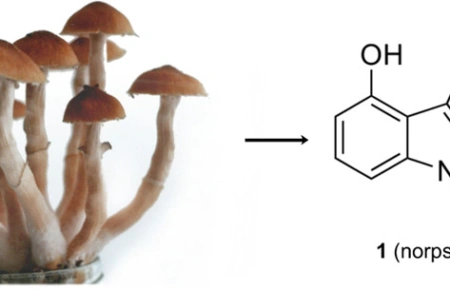
Norpsilocin is a compound structurally similar to psilocin, the primary chemical responsible for the psychedelic effects of “magic mushrooms.” Scientists discovered norpsilocin in 2017. A few years later, a team developed a synthetic method to produce this compound and other minor chemicals from “magic mushrooms” for further research. They conducted the first biological tests of norpsilocin and found that it might be even more potent than psilocin.
This article explores norpsilocin, its scientific discovery, what science tells us today, and what we still do not know about this fascinating psychedelic substance.
What is Norpsilocin?
Norpsilocin (4-hydroxy-N-methyltryptamine, 4-OH-NMT) was discovered by Dr. Claudius Lenz in Germany at the Hans Knöll Institute in 2017. The discovery resulted from analyzing numerous alkaloids found in mushrooms containing psilocybin.
Researchers believe norpsilocin is a byproduct of another “magic mushroom” alkaloid, baeocystin. This means that when metabolizing baeocystin, the body converts it into norpsilocin.
There is some debate about whether norpsilocin is psychoactive. The alkaloid shows interesting activity in the lab, but it is still unknown whether these results will translate to human models.
Sources of Norpsilocin
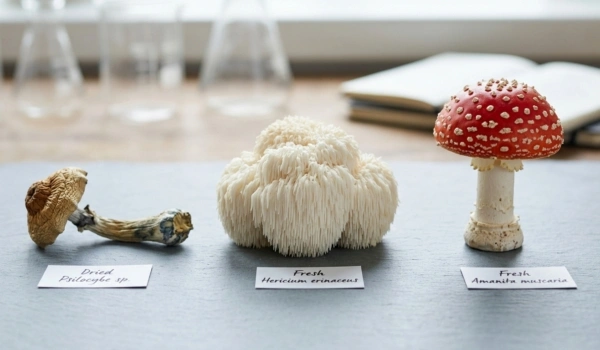
Researchers discovered norpsilocin in very small amounts in Psilocybe cubensis mushrooms. After Dr. Lenz’s initial research, norpsilocin has not been found in other plants or species. However, they believe norpsilocin forms after the body digests natural sources of baeocystin, which is found in detectable amounts in several species of “magic mushrooms.”
Researchers consider baeocystin to be a “prodrug” of norpsilocin, meaning that when consumed, the body metabolizes it into its active form, norpsilocin.
To date, the only known source of baeocystin is psilocybin-containing mushrooms. Mycologists have identified baeocystin in several mushroom genera across North and South America in small quantities, including:
- Psilocybe
- Conocybe
- Panaeolus
- Gymnopilus
- Pluteus
- Inocybe
In 2020, researcher Dr. Alexander Sherwood from the Usona Institute published a method for synthesizing crystalline forms of norpsilocin, opening the doors for more in-depth study.
Chemical Structure and Active Mechanisms of Norpsilocin
Norpsilocin is a tryptamine characterized by an indole system – a benzene and pyrrole ring – with an added 2-aminoethyl group at the third position. Norpsilocin is identical to psilocin but lacks an additional methyl group, altering its shape and seemingly affecting its psychoactivity.
Dr. Sherwood’s research suggests that norpsilocin is a potent agonist of 5HT2A receptors. The 5HT2A receptor is part of the serotonin system and is located in brain regions associated with memory, cognitive function, and psychedelic effects. While psilocin is a partial agonist, norpsilocin almost fully matches these receptors.
Norpsilocin’s affinity for 5HT2A in controlled lab conditions is intriguing, but scientists need further research. Initial tests of norpsilocin on mice did not show psychoactive effects, and human data is currently unavailable. Only a small number of studies on norpsilocin exist, but researchers have theories regarding its lack of psychoactivity:
- Norpsilocin may struggle to cross the blood-brain barrier to bind with receptors. Dr. Sherwood suggests that norpsilocin might not be sufficiently lipophilic to reach the brain.
- Monoamine oxidase (MAO), an enzyme in the body that rapidly metabolizes neurotransmitters like norpsilocin, may also play a role. Norpsilocin is a secondary metabolite of baeocystin, making it more vulnerable to MAO degradation than other mushroom compounds.
Effects of Norpsilocin
Norpsilocin’s effects on the serotonin system are intriguing, but it is too early to determine whether it has psychoactive or therapeutic effects in humans. One study on mice examined norpsilocin’s effect on time perception but found no significant effects.
Nevertheless, some psychonauts have experimented with the prodrug baeocystin and reported psychoactive results. These anecdotes serve as motivation for further research:
- Mycologist Paul Stamets reported dilated pupils and reduced anxiety but no other psychoactive effects during a self-experiment with norpsilocin’s prodrug, baeocystin.
- Chemist and mycologist Jochen Gartz, in his book “Magic Mushrooms Around the World,” claimed that various doses of baeocystin produced psychoactive effects. However, no other studies or confirmations exist regarding the psychoactivity of baeocystin or norpsilocin in humans.
Benefits of Norpsilocin and the Entourage Effect
Norpsilocin may (or may not) exhibit psychoactive effects on its own. However, scientists believe the compound may play a role in the “entourage effect” of “magic mushrooms.”
The term “entourage effect” was introduced by cannabis legend Raphael Mechoulam and suggests that consuming the full spectrum of a plant’s active compounds, rather than a single chemical, enhances therapeutic and psychoactive effects.
For example, “magic mushrooms” contain several active ingredients, including:
- Aeruginascin
- Baeocystin
- Norbaeocystin
- Psilocin
- Psilocybin
Legal Status of Norpsilocin
Norpsilocin is a relatively new derivative, and its psychoactivity is unconfirmed. These factors likely contribute to its lack of regulation as a controlled substance in the U.S. or anywhere else in the world.
However, norpsilocin is technically an analog (a similar compound) of psilocybin. This fact makes it possible that federal legislation, such as the U.S. “Federal Analog Act,” could pose legal issues for those attempting to market related products.
Conclusion
Norpsilocin is a newly discovered chemical compound closely related to psilocin, the primary active ingredient in “magic mushrooms.” While researchers have found norpsilocin in small amounts in psilocybin-containing mushrooms, its psychoactive effects on humans remain unknown.