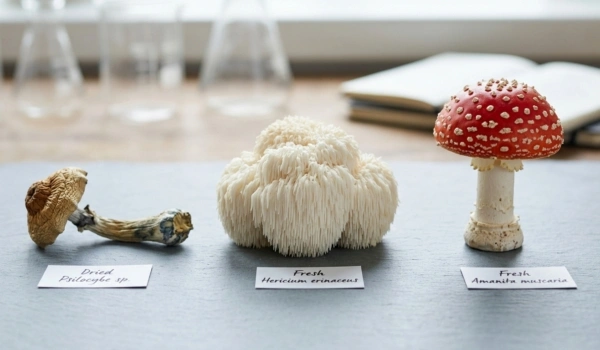

Lion’s mane mushroom is not a proven or approved treatment for ADHD. What exists is early, indirect evidence: a 2023 double-blind pilot RCT found that a single dose of Hericium erinaceus extract significantly improved performance on the Stroop task — a measure of attention and cognitive inhibition — in healthy young adults. No clinical trial has tested lion’s mane specifically in people with ADHD. Understanding what the science actually shows, and where it stops, matters more than the headline claims.
What Lion’s Mane Does in the Brain: NGF, BDNF, and the Compounds Behind the Effect
Lion’s mane contains two groups of bioactive compounds — hericenones, found in the fruiting body, and erinacines, found in the mycelium — that stimulate the synthesis of nerve growth factor (NGF) and brain-derived neurotrophic factor (BDNF). These proteins support neuron growth, synaptic plasticity, and the maintenance of existing neural connections. That is the mechanistic basis for most cognitive claims made about Hericium erinaceus.
NGF stimulation is particularly relevant to discussions about ADHD because NGF plays a role in the development and maintenance of the cholinergic system, which is involved in attention and memory. When researchers discuss why lion’s mane might theoretically matter for cognitive symptoms, the NGF and BDNF pathways are the biological foundation they point to — not a therapeutic claim, but a plausible mechanism worth understanding.
What lion’s mane does not do is directly stimulate dopamine or norepinephrine release. FDA-approved ADHD medications such as methylphenidate and amphetamine salts work primarily by acting on these catecholamine pathways. Lion’s mane operates through a different mechanism entirely — one that supports neuronal growth and plasticity rather than immediate neurotransmitter availability. This distinction shapes every honest comparison between the supplement and prescribed medication.
Can Lion’s Mane Help with ADHD Symptoms? What Current Research Shows
No clinical trials have specifically evaluated lion’s mane for ADHD treatment in children or adults as of 2025–2026. That absence is the most important fact to hold when reading enthusiastic coverage of this topic. What does exist is a small body of human and preclinical research that touches on cognitive domains ADHD directly disrupts — attention, executive function, and working memory — but in different populations and contexts.
The most relevant human data comes from a 2023 double-blind pilot RCT published in a peer-reviewed journal. The study recruited healthy young adults — not people with ADHD — and measured cognitive performance and mood at multiple timepoints. Participants who received a single dose of Hericium erinaceus extract performed significantly faster on the Stroop task at 60 minutes post-dose compared to placebo (p = 0.005). The Stroop task is a well-established measure of selective attention and cognitive inhibition: two functions that are notably impaired in ADHD.
Over 28 days of supplementation, the study also found a trend toward reduced subjective stress in the lion’s mane group (p = 0.051), though this did not reach conventional statistical significance. The study assessed working memory and episodic memory as well — both areas of difficulty in ADHD — though the primary finding was the acute Stroop improvement.
The limitations are real and worth stating plainly. This was a pilot RCT in a healthy young adult population. Faster Stroop performance in people without ADHD does not tell us whether lion’s mane reduces ADHD symptom severity, improves daily functioning in ADHD patients, or produces any clinically meaningful change for someone with a diagnosis. The cognitive mechanisms overlap, but the populations are not equivalent.
On the preclinical side, a proposed research protocol describes a study design using the spontaneously hypertensive rat (SHR) model — an animal model that exhibits ADHD-like symptoms including impaired working memory and executive functioning — to test whether lion’s mane supplementation can improve these outcomes. This protocol has not produced results; it represents where preclinical research is heading, not what it has found. The existence of the protocol does suggest that researchers see enough mechanistic plausibility to design formal tests around it.
Taken together, the evidence points to a plausible cognitive mechanism and preliminary human data showing an effect on attention-relevant tasks. It does not yet establish that Hericium erinaceus improves ADHD symptoms in people who have the condition.
How Lion’s Mane Differs from Prescribed ADHD Medications
Prescribed ADHD medications work by increasing the availability of dopamine and norepinephrine in the synaptic cleft. Methylphenidate blocks the reuptake of these neurotransmitters; amphetamine salts both block reuptake and stimulate their release. The effect is relatively fast — users typically notice changes in attention and impulse control within one to two hours of a dose. These medications have been evaluated in large clinical trials, and their efficacy in reducing core ADHD symptoms is well-documented.
Lion’s mane works along a different pathway. Hericenones and erinacines promote the production of NGF and BDNF, which in turn support neuronal growth and synaptic plasticity over time. This is a slower, structural process rather than an acute neurotransmitter effect. The 2023 RCT did find a single-dose effect on Stroop performance, which suggests some mechanism operates quickly, but the overall model for lion’s mane is one of gradual neural support rather than immediate symptom modulation.
These are not competing treatments ranked by safety or effectiveness — they work through fundamentally different mechanisms and have been evaluated to very different degrees. Lion’s mane has no ADHD-specific clinical trial data. Prescribed ADHD medications do. Anyone considering how these approaches relate to each other should do so with their prescribing physician, not by substituting one for the other based on interest in natural options.
Dosage, Forms, and What to Look for on the Label
Lion’s mane supplement labels typically list serving sizes ranging from 500 mg to 1,800 mg of powder or extract per day. This range is general supplement guidance drawn from available sources — it is not derived from ADHD-specific clinical trials and should not be read as a clinically validated dose for any ADHD-related purpose. The 2023 pilot RCT used a Hericium erinaceus extract in healthy young adults; the exact extract specification and dose used in that study may differ from what appears on a retail label.
When comparing lion’s mane products, the source part of the mushroom matters because it determines which bioactive compounds are present. Hericenones come from the fruiting body; erinacines come from the mycelium. Both stimulate NGF, but in different concentrations depending on the extraction method and source material. A product that lists only “lion’s mane mushroom powder” without specifying whether it is fruiting body, mycelium, or a dual extract gives you less information about what you are actually consuming.
| Supplement Form | Typical Label Serving | What to Check on the Label | Key Limitation |
|---|---|---|---|
| Whole mushroom powder | 500–1,000 mg | Source part (fruiting body vs. mycelium), country of origin | Variable active compound concentration; no standardization guarantee |
| Fruiting body extract | 500–1,000 mg | Extract ratio (e.g., 8:1), hericenone content if listed | Erinacines absent or minimal; mycelium-sourced benefits not included |
| Mycelium extract | 500–1,000 mg | Erinacine content if listed; whether grown on grain (starch content) | Hericenones absent or minimal; some products may contain significant grain filler |
| Dual extract (fruiting body + mycelium) | 1,000–1,800 mg | Ratio of each source, standardized active compound percentages | Less common; higher cost; standardization varies significantly by brand |
Third-party testing is a practical quality marker worth looking for. A certificate of analysis (COA) from an independent lab confirms that the product contains what the label claims and checks for contaminants. Supplement labels that mention USP, NSF, or similar certifications, or that provide batch-level COAs on request, offer more transparency than those that do not.
Safety, Side Effects, and Who Should Check with a Doctor First
Several groups should consult a healthcare provider before adding lion’s mane to their routine. Anyone currently taking prescribed ADHD medication — stimulant or non-stimulant — should discuss the addition with their prescribing doctor, as the interaction profile between lion’s mane and ADHD medications has not been formally studied. Children with ADHD represent a particular gap: safety data for lion’s mane in pediatric populations has not been established, and age-appropriate dosing is not defined by any clinical trial. The same applies to pregnant and breastfeeding individuals, for whom safety has also not been determined.
People with known mushroom allergies or sensitivities should approach Hericium erinaceus with caution, as allergic reactions to the supplement have been reported. Those with autoimmune conditions should also check with a physician, since any supplement that influences immune activity warrants review in that context. For most healthy adults, lion’s mane is generally well-tolerated in available research, but the absence of large long-term safety trials means the full side-effect picture remains incomplete. Lion’s mane is a supplement, not a substitute for a treatment plan built with a qualified healthcare provider.
Common Questions About Lion’s Mane and ADHD
Does lion’s mane work for inattentive ADHD specifically?
There is no clinical evidence targeting any ADHD subtype. The 2023 RCT measured selective attention and cognitive inhibition via the Stroop task in healthy adults — domains relevant to inattentive symptoms — but these findings cannot be extrapolated to people with a diagnosed inattentive presentation. The question remains untested.
Can lion’s mane be taken alongside Adderall or Ritalin?
No interaction studies exist between lion’s mane and stimulant ADHD medications. Taking them together is not something current research can declare safe or unsafe. Anyone on a prescribed ADHD medication should raise this with their prescribing physician before adding any supplement, including lion’s mane.
How long does lion’s mane take to have an effect on focus?
The 2023 pilot RCT observed faster Stroop performance at 60 minutes post-dose in healthy adults, suggesting some acute cognitive effect is possible. The 28-day supplementation arm showed a trend toward stress reduction. Whether any effect on focus accumulates over weeks in people without ADHD — let alone those with ADHD — is not established. Product claims about timelines should be read with that gap in mind.
Is lion’s mane safe for a child with ADHD?
Safety data for lion’s mane in children has not been established in clinical research. Until pediatric safety and dosing are formally studied, health sources consistently recommend consulting a doctor before giving lion’s mane to anyone under 18, including children with ADHD.