What Is Maitake Mushroom (Grifola frondosa)?
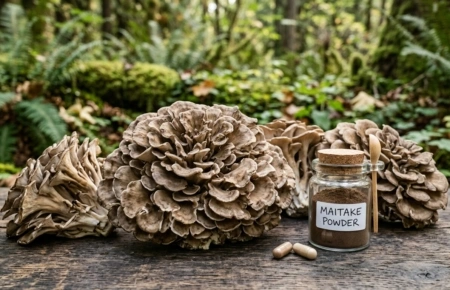
Maitake mushroom (Grifola frondosa) is a functional, non-psychedelic edible mushroom belonging to the Polyporaceae family, native to northern Japan and found in temperate woodlands across Asia, Europe, and North America. Maitake is entirely unrelated to psilocybin mushrooms, magic mushrooms, or Amanita muscaria — it belongs to the same category of functional edible mushrooms as lion’s mane, reishi, and turkey tail. The name translates roughly to “dancing mushroom” in Japanese, and the fruiting body grows in overlapping, fan-shaped clusters at the base of oak, elm, and maple trees.
In culinary contexts, maitake is valued for its earthy flavor and meaty texture. As a supplement, it is used for its bioactive polysaccharide content — specifically its beta-glucan fractions — which have attracted substantial scientific interest over the past three decades.
Key Bioactive Compounds in Maitake
The most studied bioactive compounds in Grifola frondosa are its beta-glucan polysaccharide fractions, commonly identified on supplement labels as D-fraction, MD-fraction, and SX-fraction. Each fraction has a distinct chemical structure and has been studied in different research contexts.
- D-fraction is the most widely researched and is associated with immunomodulatory and antitumor activity. Studies have examined its role in stimulating macrophage and natural killer cell function.
- MD-fraction is a more highly purified derivative of the D-fraction, developed to improve bioavailability and potency. It appears in studies examining immune support and cancer-related applications.
- SX-fraction has been studied primarily in the context of blood glucose regulation and insulin sensitivity, making it the fraction most relevant to metabolic research.
At the mechanistic level, maitake beta-glucans have been shown to stimulate hematopoietic progenitor cell differentiation and promote granulocyte colony-stimulating factor (G-CSF) production — two processes central to immune cell generation and innate immune response. This mechanism underpins much of the immunomodulatory research discussed in clinical trials.
Grifola frondosa on a dry-weight basis is composed of approximately 70–80% carbohydrates and 13–21% protein. When a product label references D-fraction or a specific beta-glucan percentage, those figures indicate how much of the polysaccharide fraction has been concentrated from the raw mushroom material.
What Research Says About Maitake’s Health Benefits
Maitake’s most consistent research-supported benefits fall across four areas: immune function, blood glucose regulation, cholesterol management, and anti-cancer activity. The strength of evidence varies across these areas, ranging from supervised human clinical trials to preclinical animal models.
Immune Support: Human Clinical Trial Evidence
The clearest human evidence for maitake extract comes from a phase II clinical trial examining its use in patients with myelodysplastic syndromes (MDS). Participants received oral maitake extract at 6 mg/kg per day for 12 weeks. The trial found the protocol was well tolerated and significantly enhanced neutrophil and monocyte function in MDS patients — two immune cell populations often impaired in this condition — with no dose-limiting toxicity reported.
A prior dose-escalation trial in breast cancer patients using 5–7 mg/kg daily over three weeks showed significant dose-related immune function changes with no serious adverse events. Both trials used clinically supervised doses in specific patient populations, which means their findings cannot be directly mapped to general supplement use — but they establish a meaningful safety and mechanistic baseline for maitake extract in immune contexts.
Blood Glucose and Insulin Sensitivity
A water-soluble maitake extract known as FXM has been studied in preclinical animal models for its effects on blood glucose. In these studies, FXM lowered circulating glucose levels and enhanced peripheral insulin sensitivity — results attributed primarily to the SX-fraction’s interaction with insulin signaling pathways. These are preclinical findings, not human clinical outcomes. Human trials specifically targeting blood sugar regulation with maitake extract remain limited.
Cholesterol and Cardiovascular Risk Factors
Maitake beta-glucans have been associated with modest reductions in LDL cholesterol in research settings, without significant changes to HDL cholesterol or triglyceride levels. This pattern is consistent with how soluble beta-glucans from other sources interact with bile acid reabsorption. The cardiovascular evidence for maitake specifically is less extensive than for other beta-glucan sources, and robust human trials in this area remain limited.
Anti-Cancer and Broader Applications
A 2024 peer-reviewed comprehensive review confirmed maitake’s anti-cancer, anti-diabetic, antimicrobial, and immunomodulatory effects across the published literature and identified Grifola frondosa as a strong candidate for nutraceutical and cosmetic applications. The review also noted CNS, immune-stimulant, and antiviral activity. The same review acknowledged that robust large-scale clinical studies remain lacking for most of these applications — the mechanistic and preclinical evidence is well-documented, but human confirmation is still developing.
Maitake Supplement Forms, Dosage, and How to Take It
Maitake supplements are available in several forms, and the practical differences between them matter when reading a product label. No universally agreed clinical dosage exists for general supplement use, and amounts used in research trials were clinically supervised — they are not equivalent to standard over-the-counter label recommendations.
| Form | Typical label serving | Research context | What to check on the label |
|---|---|---|---|
| Whole powder (capsule or loose) | 500–2,500 mg/day | Not equivalent to extract doses used in trials | Mushroom source (fruiting body vs. mycelium), filler content, beta-glucan percentage if listed |
| Standardized extract (capsule or tablet) | 500–1,500 mg/day | D-fraction and MD-fraction extracts used in clinical immune trials | Extraction ratio, D-fraction or beta-glucan standardization, third-party testing |
| Liquid tincture | Varies by concentration; follow label | Less studied in this form; extraction solvent matters | Alcohol vs. water extraction, concentration per serving, serving size |
| Powder for food or drink | Typically 1–2 g per serving | Not typically used in clinical trials | Fruiting body vs. myceliated grain, added fillers or starches |
Manufacturer-recommended daily doses vary: extract products typically suggest 12 to 25 mg of concentrated fraction per day for preventive use, while whole powder products may go up to 2,500 mg/day. The MDS phase II trial used 6 mg/kg/day of maitake extract — a dose calculated by body weight under medical supervision — which differs considerably from flat-dose commercial label recommendations and should not be replicated outside a clinical context.
When choosing a maitake supplement, look for products that specify whether the mushroom material comes from the fruiting body rather than mycelium grown on grain. Fruiting body extracts generally contain higher concentrations of the target beta-glucan fractions. Third-party testing for purity and potency is a useful quality signal, particularly given that product quality varies considerably between brands.
Anyone taking medications for diabetes, blood pressure, or blood clotting — or managing an existing health condition — should consult a qualified healthcare provider before adding a maitake supplement to their routine.
Safety, Side Effects, and Drug Interactions
Maitake supplements interact with several medication categories, and these interactions are the most practically important safety consideration before starting supplementation. Three moderate interaction categories have been documented: antidiabetic drugs, antihypertensive drugs, and blood thinners.
The antidiabetic interaction is the most mechanistically plausible — maitake’s SX-fraction has been studied for glucose-lowering effects, which means combining maitake extract with insulin or oral hypoglycemic agents could amplify blood sugar lowering beyond the intended range. Similarly, maitake’s reported effects on blood pressure mean it may add to the effect of antihypertensive medications. For anticoagulants, one case report has documented an interaction with warfarin — this is a single case report, not a controlled pharmacological study, but it is sufficient to warrant caution for anyone on anticoagulant therapy. Anyone taking warfarin or similar blood thinners should speak with their prescriber before using maitake extract.
Maitake supplementation is not recommended during pregnancy or breastfeeding, as insufficient safety data exists to support its use during either period. For anyone scheduled for surgery, maitake supplements should be discontinued at least two weeks before the procedure, given the potential for interaction with anesthesia-related blood pressure management and anticoagulation protocols.
Mild gastrointestinal effects — nausea and diarrhea — are the most commonly reported adverse effects in published literature and are generally self-limiting. These are more likely at higher doses or when starting supplementation on an empty stomach.
Maitake is generally well tolerated in healthy adults at label-recommended amounts, but its combination of immunomodulatory and metabolic activity means it warrants care alongside prescription medications. A conversation with a healthcare provider is the most practical first step for anyone managing a chronic health condition.