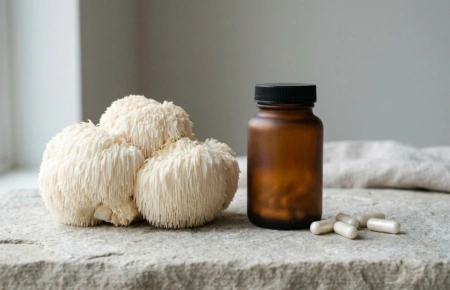
Lion’s mane mushroom (Hericium erinaceus) is generally well tolerated by most healthy adults, and the side effects that do occur are typically mild and gastrointestinal in nature. Clinical trial data comparing lion’s mane to placebo at 3 g/day found adverse event rates were similar between the two groups. Rare but documented allergic reactions have also been reported, particularly in people with existing mushroom or mold sensitivities. For most people without relevant risk factors, the Hericium erinaceus safety profile is favorable based on current evidence — but several groups need to take specific precautions before use.
Most Commonly Reported Side Effects of Lion’s Mane
The most frequently reported lion’s mane side effects are mild gastrointestinal symptoms: abdominal discomfort, nausea, and loose stool. These symptoms appeared in a 16-week clinical study at rates that closely matched the placebo group — stomach discomfort and diarrhea were reported by 7 participants taking lion’s mane compared to 6 in the placebo group, with all cases rated as mild and requiring no treatment.
One participant withdrew from the trial due to stomach discomfort, which indicates that GI sensitivity is the most clinically relevant mild side effect for a small subset of users. Skin rash has also been reported in clinical studies as an occasional side effect, though it is less common than GI symptoms.
The clinical picture for most healthy adults is mild: GI symptoms appear at rates similar to placebo and tend to resolve without intervention. Lion’s mane is not entirely side-effect-free, but the documented adverse events at studied doses are generally low-grade and self-limiting.
Serious Side Effects and Allergic Reactions
Allergic reactions to lion’s mane supplements are rare, but they are documented. Reported reactions include skin rash and, in at least one case, a respiratory reaction — a more serious response that highlights why people with known mushroom or mold allergies should not use lion’s mane without medical clearance.
The risk appears concentrated in individuals who already have sensitivities to fungi. Anyone who experiences breathing difficulty, significant skin reactions, or swelling after taking lion’s mane should stop use immediately and seek medical attention.
Who Should Avoid Lion’s Mane
Several specific groups should either avoid lion’s mane or consult a qualified healthcare professional before starting supplementation. The reasons differ by group, so the practical guidance is not the same for everyone.
| Group | Reason for Caution |
|---|---|
| Pregnant or breastfeeding individuals | Insufficient safety data exists for this population |
| People taking blood-thinning medications | Lion’s mane has mild antiplatelet properties that may compound anticoagulant effects |
| Individuals with autoimmune conditions | Immune-modulating properties of lion’s mane may be relevant and unpredictable |
| People managing diabetes with medication | Lion’s mane may have blood sugar-lowering effects that could amplify medication action |
| Anyone scheduled for surgery within two weeks | Antiplatelet properties are a precaution in surgical and bleeding contexts |
| Individuals with mushroom or mold allergies | Documented risk of allergic reaction, including respiratory response |
Children are another group where safety data is insufficient, and lion’s mane supplementation for children should not be considered without explicit guidance from a pediatric healthcare provider. If you fall into any of the categories above, the practical step is to raise it with a qualified professional before starting use.
Drug Interactions and Special Precautions
Two medication categories carry the clearest interaction concern with lion’s mane supplements: blood-thinning medications and diabetes medications.
Lion’s mane has mild antiplatelet properties, meaning it may slow blood clotting to a modest degree. For someone already taking anticoagulant or antiplatelet medications — such as warfarin, aspirin at therapeutic doses, or newer blood thinners — adding lion’s mane could compound that effect. This is particularly relevant in the two weeks before any surgical procedure.
For individuals managing blood sugar with medication, lion’s mane may have a blood sugar-lowering effect of its own. Taking it alongside diabetes medications without monitoring could increase the risk of blood glucose dropping lower than intended. Discussing this with the prescribing physician or a pharmacist who can review the full medication picture is the appropriate step before starting.
Patients already undergoing cancer treatment represent a specific context where professional consultation is especially important. The Oncology Nursing Society notes that patients in active cancer treatment should discuss lion’s mane supplementation with their oncology and integrative medicine teams, including their pharmacist, before use. This is not because lion’s mane is a cancer treatment — it is not — but because polypharmacy and immune interactions in treatment contexts require professional review that a supplement label cannot provide.
What Clinical Trials and Toxicology Research Say About Safety
The clearest recent evidence on lion’s mane safety comes from a 2025 peer-reviewed study published in Frontiers in Toxicology, which confirmed that lion’s mane powder is non-genotoxic and produced no treatment-related adverse effects at any tested dose across acute and subchronic toxicity assessments. The evaluations covered clinical observations, body weight, haematology, serum chemistry, urinalysis, and histopathology — a comprehensive toxicology screen that returned no safety signals at the doses tested.
In human clinical trials, adverse event rates for lion’s mane at 3 g/day were comparable to placebo. For most healthy adults, this suggests that adding lion’s mane to a daily routine does not meaningfully increase the rate of side effects above what people experience without any supplement.
Additional clinical data adds context. A 7-day pilot study in 13 healthy adults taking 1 g three times daily found no significant effects on routine hematological markers. An 8-week randomized trial in 77 overweight adults observed significant improvements in depression scores, anxiety scores, and sleep quality among those taking lion’s mane extract, with no serious adverse events reported in either group. These are trial observations in specific study populations — they are not evidence that lion’s mane treats depression or anxiety as a condition.
There are real limitations to acknowledge. Most clinical trials have run for up to 49 weeks, so the long-term safety picture for extended high-dose use is not yet fully characterized. The toxicology data also carries a product-form caveat: findings from one preparation — fruiting body, mycelium, or primordia — may not transfer directly to another. A product made primarily from mycelium has a different compound profile than a fruiting body extract, and safety data from one should not be assumed to apply to the other. Checking which part of the mushroom a product uses is a practical and relevant label-reading step.
What to Do Before Starting a Lion’s Mane Supplement
For most healthy adults without the risk factors described above, current evidence supports a favorable safety profile for lion’s mane. A few practical checks before starting are still worth the time.
- Check for mushroom or mold allergies. If you have a history of fungal allergies, discuss lion’s mane with an allergist or physician before trying it.
- Review your current medications with a pharmacist. If you take blood thinners, diabetes medications, or immunosuppressants, a pharmacist can assess whether lion’s mane is appropriate alongside your current regimen.
- Identify whether you belong to an at-risk group. Pregnancy, breastfeeding, upcoming surgery, and autoimmune conditions are all reasons to get professional input first.
- Check the product form on the label. Whether a product is made from the fruiting body, mycelium, or primordia affects which safety data is most relevant to it. The label should disclose this clearly.
If you start lion’s mane and notice persistent GI discomfort, a skin reaction, or any breathing difficulty, stop use and consult a healthcare professional. For most people those situations will not arise — but knowing what to watch for makes the decision to start more informed.