What Is Chaga?
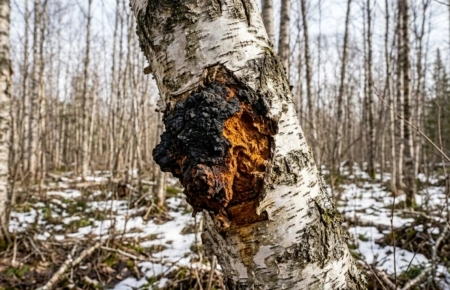
Chaga (Inonotus obliquus) is a fungus that grows on the bark of birch trees across cold northern climates — Siberia, Russia, Northern Europe, Korea, Canada, and Alaska. It does not look like a typical mushroom. Rather than forming a cap and stem, it produces a dark, irregular mass on the tree’s exterior that resembles a large piece of burnt charcoal, with a softer rust-orange interior.
Biologically, chaga is a parasitic fungus that colonizes birch trees over many years, drawing on the tree’s nutrients as it develops. This slow growth is part of why it accumulates a dense range of secondary compounds. The hard, charcoal-like exterior growth is what gets harvested — not a fruiting body in the conventional sense.
Chaga is not eaten as food the way shiitake or oyster mushrooms are. Its texture is woody and its flavor intensely bitter, making direct consumption impractical. Traditionally, and still today, it is most commonly prepared as a tea by simmering chunks or powder in hot water, which draws out the water-soluble compounds.
Traditional Uses and History
In Siberian and Russian folk medicine, chaga has been used for centuries as a general health tonic. Historical uses include support for digestive complaints and immunity, and it was sometimes applied externally. Scandinavian cultures also adopted it, particularly as a tea substitute during periods when conventional trade goods were scarce.
Beyond medicinal use, chaga has a documented history in pipe-smoking rituals in some northern communities. Its presence across Siberian, Russian, Korean, and Northern European traditions reflects how widely it was integrated into daily life in regions where birch forests dominate the landscape. It has also drawn interest for applications in pharmaceuticals, food, cosmetics, and agriculture.
Centuries of traditional use tells us that people valued this fungus and found it tolerable to consume over long periods. It does not, on its own, confirm specific clinical effects. Traditional history provides cultural context, not medical evidence.
Bioactive Compounds in Chaga
Researchers studying Inonotus obliquus have identified several classes of bioactive compounds thought to underlie its observed biological activity in laboratory settings.
Polysaccharides are among the most studied components. These complex carbohydrates are associated with immune-modulating properties in cell and animal research — a pattern shared with several other functional fungi.
Triterpenoids are a broad group of naturally occurring compounds also found in chaga. In vitro research has examined their potential role in inhibiting alpha-glucosidase, an enzyme involved in carbohydrate digestion, which has drawn interest in the context of blood sugar regulation. These findings come from cell-based models, not human studies.
Polyphenols — including gallic acid, protocatechuic acid, and p-hydroxybenzoic acid — contribute to chaga’s antioxidant profile. These phenolic acids help explain the relatively high antioxidant activity measured in chaga extracts in laboratory assays.
Lignin metabolites and other secondary compounds round out the profile. Chaga also contains oxalic acid, which is relevant not only as a bioactive molecule but as a meaningful safety consideration covered in the section below.
What these compounds do in a laboratory dish or in a rodent model does not automatically translate to the same effect in a person taking a capsule or drinking a tea. The compounds are real and measurable; what they do inside the human body at supplement quantities remains an open question.
What Research Has Looked At
Scientific interest in chaga has grown steadily. A review covering literature published between 1900 and 2022 — spanning roughly 90 documents — mapped the range of biological activities studied for Inonotus obliquus extracts. A 2024 review continued to document expanding research interest in the fungus’s compound profile and mechanisms of action.
The activities explored in this body of work include:
- Antioxidant and anti-inflammatory effects
- Immune system modulation
- Anticancer activity in cell line and animal studies
- Antidiabetic effects, including potential improvements in insulin resistance
- Hepatoprotective and renoprotective properties
- Antiviral and antibacterial activity
- Anti-fatigue and anti-obesity effects in animal models
That is a broad list, and it reflects genuine scientific curiosity. Some studies have begun identifying specific mechanisms — for example, how certain terpenoids interact with enzymes in metabolic pathways, or how polysaccharides appear to influence immune cell activity in controlled conditions.
The critical limitation is consistent across all of this work: virtually all findings come from in vitro (cell-based) or animal studies. As Memorial Sloan Kettering Cancer Center notes in its integrative medicine database, the safety and efficacy of chaga have not been evaluated in human clinical studies. There are no controlled trials in people establishing that chaga supplements produce the outcomes observed in laboratory settings.
Preliminary findings from animal and cell models are how research typically begins — they are a starting point, not a conclusion. What the current evidence does show is that the compounds in this fungus interact with biological systems in ways researchers consider worth investigating further. Describing chaga as proven to treat inflammation, cancer, or diabetes in humans would go well beyond what the data supports.
Chaga Supplement Forms and Serving Guidance
Chaga is available in several forms, each with practical differences in preparation, compound extraction, and what to look for on a label. There is no established clinical dosage from human trials, so any figures on product labels represent the manufacturer’s serving suggestion rather than a medically validated amount.
| Form | How It Is Typically Used | What to Check on the Label | Practical Note |
|---|---|---|---|
| Tea (chunks or coarse powder) | Simmered in hot water for 15–20 minutes; strained and consumed as a beverage | Whether it is raw chaga or an extract; sourcing and harvest region | Traditional method; water extraction captures water-soluble polysaccharides but not all compound classes |
| Powder (fine-ground) | Mixed into water, coffee, or other drinks; stirred into food | Whether it is whole mushroom powder or an extract; extract ratio if listed | Bioavailability depends on extraction method; raw powder may differ significantly from dual-extracted products |
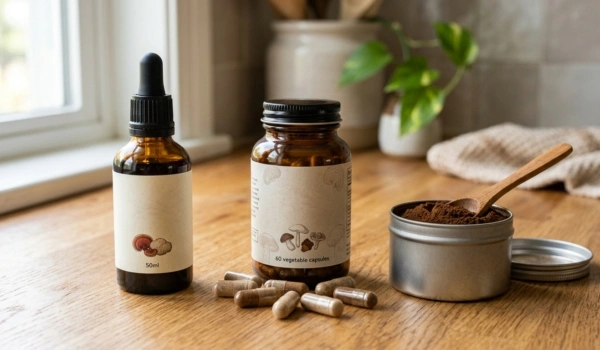
| Capsules / tablets | Taken with water; label serving typically around 500–1,000 mg of extract daily | Extract type (water, ethanol, dual); standardization claims; third-party testing | Convenient; potency varies widely between brands depending on source material and extraction process |
| Liquid tincture | Taken by dropper; often diluted in water or held briefly under the tongue | Solvent used (alcohol, water, glycerin); concentration per serving | Alcohol-based tinctures may extract different compounds than water; not suitable for everyone |
Product potency varies considerably depending on how the raw material was harvested, processed, and extracted. A capsule labeled “chaga extract” may use water extraction, ethanol extraction, or a dual extraction — each pulling different compounds from the fungus. Labels do not always make this clear. Looking for products that specify the extraction method and provide third-party testing results is a practical starting point when evaluating quality.
Because no human trials have established a therapeutic dose, the serving sizes on commercial products — typically in the 500–1,000 mg range for extract capsules — are manufacturer guidelines, not clinical recommendations.
Safety, Side Effects, and Interactions
Chaga’s long traditional history and its status as a non-psychedelic functional mushroom can create an impression of general safety. The actual picture is more nuanced, and several specific risks warrant serious attention before starting a chaga supplement.
Drug Interactions
Anticoagulant and antiplatelet medications: Chaga may interact with drugs that affect blood clotting, including warfarin and aspirin at antiplatelet doses. The concern is that compounds in chaga could enhance anticoagulant effects, increasing bleeding risk. Anyone taking blood thinners should not add chaga without first speaking with their prescribing physician.
Diabetes medications: Preliminary research suggesting antidiabetic activity in animal models raises a practical concern: if chaga lowers blood sugar even modestly, combining it with insulin or oral hypoglycemic agents could push blood glucose too low. People managing diabetes should discuss this risk with their healthcare provider before use.
Kidney and Oxalate Risk
This is the most clinically significant safety concern specific to chaga. Oxalic acid — one of the compounds identified in chaga extracts — can contribute to kidney stone formation, particularly calcium oxalate stones. For people with a history of kidney stones, existing kidney disease, or reduced kidney function, consuming chaga regularly represents a meaningful risk of worsening their condition.
There are documented case reports of individuals developing oxalate nephropathy — a form of kidney damage caused by oxalate accumulation — associated with heavy chaga consumption. This is not a theoretical concern. People with kidney disease or a history of kidney stones should avoid chaga supplements.
Pregnancy and Breastfeeding
The safety of chaga during pregnancy or breastfeeding has not been studied. Given the absence of safety data and the known presence of biologically active compounds, use during pregnancy or while breastfeeding is not advisable without explicit guidance from a qualified healthcare professional.
General Cautions
Potency varies considerably across chaga products, meaning the amount of active compounds a person actually receives from one product to the next is unpredictable. This variability makes it harder to assess risk or consistency of effect. The absence of human clinical data means there is no established safe dose, no clear therapeutic window, and no validated guidance on how long supplementation should continue.
Anyone considering chaga — particularly those taking prescription medications, managing a chronic health condition, or with any history of kidney problems — should consult a qualified healthcare professional before starting. Given the drug interaction profile and the oxalate risk, that conversation is a genuinely important step, not a routine disclaimer.
For those without these risk factors, chaga tea or a well-sourced extract may fit into a balanced approach to health — but that assessment is best made with an accurate understanding of what current evidence does and does not support, and ideally with input from someone who knows your full health picture.