What Is Turkey Tail Mushroom?
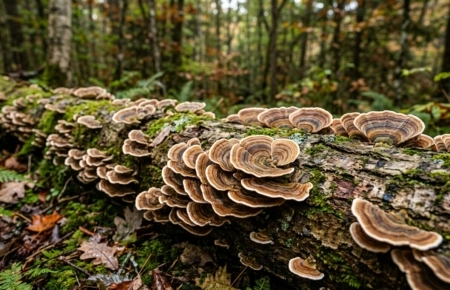
Turkey tail mushroom (Trametes versicolor, also known historically as Coriolus versicolor) is a functional mushroom found on dead and decaying wood across forests worldwide. Its common name comes from the concentric bands of brown, tan, and rust-colored rings that resemble a wild turkey’s fanned tail feathers. This is a functional, non-psychedelic mushroom — it has no connection to psilocybin, magic mushrooms, or Amanita muscaria, and produces no psychoactive effects.
In East Asian traditional medicine, turkey tail has been consumed as both a food and a medicinal preparation for centuries. Teas and decoctions made from the dried mushroom appear in traditional Chinese and Japanese herbalism, where it was associated with immune health and general vitality. Today, it is one of the most widely studied functional mushrooms, with its bioactive compounds drawing particular attention in oncology support research.
Key Bioactive Compounds: PSK, PSP, and Beta-Glucans
The most studied compounds in turkey tail are two protein-bound beta-glucan polysaccharides: polysaccharide-K (PSK, also called krestin) and polysaccharopeptide (PSP). Both are large carbohydrate-protein complexes derived from the mushroom’s cell walls. While they share a molecular category, PSK and PSP are distinct compounds with different structures and separate bodies of research.
PSK has the longer clinical history. It received regulatory approval in Japan as an adjunct treatment for gastrointestinal cancers in the 1970s and continues to be used in that role today. This approval is specific to Japan — PSK is not approved as a cancer treatment or adjunct in most Western countries, and turkey tail supplements sold outside Japan are not equivalent to the pharmaceutical-grade PSK preparations used in Japanese oncology settings.
PSP has been studied primarily in laboratory and early clinical settings, particularly in China. Beyond these two headline compounds, turkey tail also contains phenolic compounds and triterpenes that may contribute to its antioxidative and antimicrobial properties, though these have received less research attention than PSK and PSP.
At a mechanistic level, turkey tail acts as a nonspecific immune modulator. Its polysaccharides interact with immune receptors and have been shown in research settings to stimulate activity in macrophages, dendritic cells, and CD8+ T cells — immune cells involved in identifying and responding to abnormal or foreign cells. This is why it attracts interest in cancer-adjacent research: not as a direct cancer-killing agent, but as a potential support for immune function during and after treatment.
What Research Shows About Turkey Tail
Turkey tail has one of the broader research profiles among functional mushrooms, but the type of evidence varies considerably depending on the health area. The distinction between lab findings, animal data, and human clinical results matters when evaluating what is actually known.
Cancer Adjunct Use: Clinical Evidence
The strongest human evidence for turkey tail centers on its use alongside conventional cancer treatments. A 2023 systematic review and meta-analysis examined PSK from turkey tail in the context of gastrointestinal cancer and found an association with improved survival rates. PSK has also been studied for its potential to reduce certain side effects of chemotherapy in colorectal cancer patients. These are clinical findings — drawn from human trials, not from cell cultures or animal models.
Precision matters here. The clinical research addresses PSK used as an adjunct — meaning alongside, not instead of, standard cancer care. Turkey tail mushroom supplements available as general wellness products are not the same as the regulated PSK preparations used in Japanese oncology settings and should not be treated as equivalent.
Gut Microbiome: Early Human and Review Data
A 2017 review of prior studies noted that turkey tail may promote healthy gut bacteria and influence microbiome composition. The polysaccharides in turkey tail appear to act as prebiotics, providing a substrate that beneficial bacteria can use. This area has plausible biological reasoning and some supportive early data, but large-scale clinical trials specifically examining gut health outcomes in humans remain limited.
Anticancer Cell Effects: Laboratory Data
A 2019 laboratory study found that PSP from turkey tail extract may inhibit colon cancer cell growth and prevent cancer cell migration in cell culture models. In vitro findings like this help researchers understand how a compound might work, but they do not translate directly to clinical outcomes in humans. Lab results are a starting point, not a clinical conclusion.
Antioxidant and Immunomodulatory Properties
Across both preclinical and some clinical settings, turkey tail has demonstrated antioxidative and immunomodulatory activity consistent with the known chemistry of its beta-glucans and phenolic compounds. Antioxidant effects are measurable, but this property is shared by many plant and fungal foods, and its clinical significance in supplement form is less clearly defined for general populations.
How to Take Turkey Tail Mushroom
Turkey tail supplements are available in several forms. There is no officially recommended dosage for turkey tail as a dietary supplement. General informational guidance based on common supplement label conventions suggests around 1–3 grams of turkey tail powder daily for immune support and general wellness. This is not a medical recommendation and is not an appropriate self-managed starting point for anyone using turkey tail in the context of a serious health condition — higher amounts in clinical contexts require healthcare provider supervision.
| Form | How It Is Typically Used | What to Check on the Label | Practical Notes |
|---|---|---|---|
| Powder | Mixed into water, smoothies, or food; one of the most flexible forms | Whole mushroom powder vs. extract; beta-glucan content if listed | Extract powders are more concentrated than whole mushroom powders; serving sizes vary by product |
| Capsules | Convenient fixed-dose format; easiest for consistent daily use | Milligrams per capsule; extract ratio (e.g., 10:1) if applicable; fillers and allergens | Compare total daily amount across the full serving recommendation, not just per capsule |
| Tea / Dried mushroom | Traditional preparation; brewed from dried pieces | Species confirmation (Trametes versicolor); no added ingredients | Compound concentration varies; bioavailability from tea may differ from standardized extracts |
| Liquid tincture / Extract | Drops added to liquid; alcohol or hot-water extracted | Extraction method; concentration per serving | Alcohol-based tinctures may not extract beta-glucans as effectively as hot-water or dual-extraction methods |
When choosing a turkey tail supplement, look for products that clearly identify the species as Trametes versicolor, specify whether the product is a whole mushroom, mycelium-based, or a fruiting body extract, and ideally carry third-party testing for purity and identity. Beta-glucan content listed on the label is a useful quality marker when present.
Anyone taking medications, managing a chronic condition, pregnant, or breastfeeding should speak with a qualified healthcare professional before adding turkey tail to their routine — particularly anyone in active cancer treatment.
Safety, Side Effects, and Who Should Be Careful
A 2025 animal study published in PMC found no acute toxicity and no subchronic oral toxicity in rats given turkey tail powder at doses up to 2000 mg per kilogram of body weight per day. No genotoxicity was detected in either in vitro or in vivo assays. These findings are encouraging, but they come from animal models. Human safety data, while generally consistent with these results in the context of moderate supplement use, is less comprehensively studied at high doses.
Reported side effects in human use have generally been mild and include digestive symptoms such as nausea, bloating, or darkening of stool. Allergic reactions are possible, as with any mushroom product.
The more clinically significant concern is interaction risk tied to turkey tail’s immune-modulating activity. Because PSK and PSP influence immune cell activity, turkey tail may interact with treatments that also target immune function. UCLA Health advises that patients inform their doctors before using turkey tail mushrooms, noting that its immune-modulating effects can cause side effects or interact with cancer treatments. This is a practical caution grounded in the mechanism of action, not an unusual restriction.
Groups who should consult a healthcare provider before using turkey tail:
- People currently undergoing chemotherapy, radiation, or other cancer treatments
- Anyone taking immunosuppressant medications, including transplant recipients
- People with autoimmune conditions, where immune modulation could affect disease activity
- Pregnant or breastfeeding individuals, for whom supplement safety data is insufficient
- Children, where appropriate serving amounts and safety have not been established
- Anyone scheduled for surgery, as immune-modulating supplements are sometimes flagged pre-operatively
Turkey tail is a well-studied functional mushroom with a reasonable safety profile for healthy adults using it in moderate amounts, but its biological activity is real — and that activity can matter in specific medical contexts. The available clinical review data supports cautious, informed use rather than either dismissal or uncritical enthusiasm.