
anxiety disorders
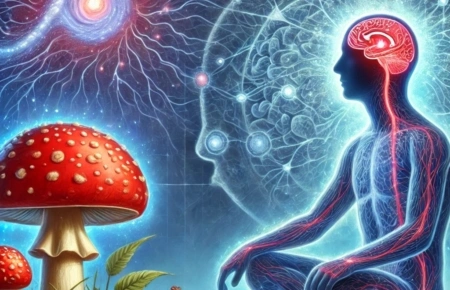
Muscimol, a substance found in the fly agaric, actively affects the receptors for gamma-aminobutyric acid (GABA), the brain’s main inhibitory neurotransmitter. As a result, muscimol has a calming effect, reducing the excitation of nerve cells.
This makes it an interesting subject to study in the context of treating fear and anxiety disorders.
Many psychiatric disorders, such as anxiety and post-traumatic stress disorder (PTSD), are associated with impairments in fear management processes. Therefore, the study of substances that can affect brain fear centers is an important area in neurobiology and psychiatry. Muscimol, due to its ability to interact with GABA receptors, becomes a key candidate for this kind of research.
What does the amygdala body have to do with fear?
The almond-shaped body (amygdala) is an area of the brain that plays a key role in how we learn to fear and respond to threats.
- In studies such as “The role of the amygdala in conditioned and unconditioned fear and anxiety” (Davis, 1992), it has been shown that the amygdala is activated upon encountering a threat and is involved in the formation of conditioned fear reflexes.
- If you reduce the activity of this area, the level of fear and anxiety decreases.
The amygdala is not only involved in the response to danger, but also in the process of remembering it. For example, inhibitory agents such as muscimol can temporarily suppress the fear response, opening up the possibility of therapies for traumatic memory disorders.
How does muscimol affect fear?
Helmstetter & Bellgowan’s (1994) experiment examined how muscimol acts on the amygdala body.
- Rats were trained to associate a sound with an unpleasant stimulus to induce conditioned fear.
- After injection of muscimol into the amygdala, the fear response was significantly reduced: rats were less likely to freeze in response to sound.
This shows that muscimol temporarily blocks amygdala activity and helps reduce fear. This effect may be useful in reducing traumatic memories.
Moreover, muscimol is helping to investigate how the brain processes and stores fear. Understanding these processes is important for developing new approaches to treat anxiety disorders. It is important to note that such experiments provide insights into the mechanisms of brain function, but so far remain predominantly in the realm of preclinical research.
Can muscimol have a long lasting effect?
Although muscimol is short-lived, its effect on fear extinction can lead to long-term changes in the brain.
- For example, the prefrontal cortex, which controls emotions and helps to retain positive changes in memory, plays an important role in perpetuating the effect.
- The combined effects of muscimol on the amygdala and prefrontal cortex may provide a basis for the treatment of posttraumatic stress disorder (PTSD)
The research also shows that when muscimol is administered repeatedly in a therapy setting, sustained changes in the way the brain processes danger signals can be achieved. This opens new horizons for the use of substances acting on GABAA receptors in the context of long-term treatment.
What are the perspectives and limitations?
Muscimol opens new possibilities in the treatment of anxiety disorders, but there are limitations:
- Limited research: most studies have been conducted on animals and the results need to be confirmed in humans.
- Dosage and safety: it is important to determine optimal doses that will be effective but safe for patients.
An interesting direction is the study of synthetic analogs of muscimol, which could have a similar therapeutic effect but fewer side effects. This could significantly accelerate the introduction of such approaches into clinical practice.
Conclusion
Muscimol is a promising substance for studying the mechanisms of fear extinction and treating anxiety disorders. Its ability to reduce the activity of the amygdala and prefrontal cortex makes it a useful tool for neurobiology. However, before muscimol can be used in medicine, more research is needed into its efficacy and safety in humans.
Understanding the mechanisms through which muscimol affects the brain may also lead to the creation of new therapeutic approaches. Such research not only helps to combat anxiety disorders, but also contributes to the general understanding of how the brain works during emotional reactions.