What Is a Lion’s Mane Supplement?
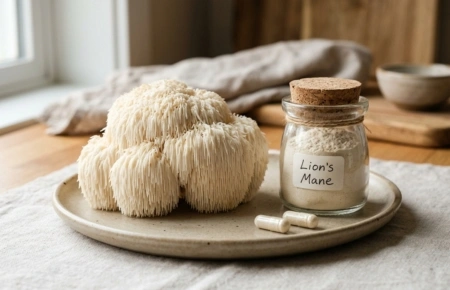
Lion’s mane (Hericium erinaceus) is a legal, non-psychedelic functional mushroom sold as a dietary supplement in the United States and many other countries. Lion’s mane contains no hallucinogenic compounds and is not related to psilocybin mushrooms, Amanita muscaria, or any psychedelic microdosing product — it works through an entirely different biological mechanism. The supplement is primarily used for brain health, with research pointing to neuroprotective and antioxidant properties as the basis for that interest.
The four main product forms are:
- Capsules — pre-measured servings, convenient for daily use
- Powder — versatile, can be added to drinks or food, but serving size requires careful measuring
- Extract — concentrated form, typically higher active compound content per gram
- Tincture — liquid form, often alcohol or water-based dual extraction
Beyond the form, the most important source distinction is whether a product uses the fruiting body (the visible mushroom) or the mycelium (the root-like network, often grown on grain). This distinction directly affects which bioactive compounds are present and at what concentration. No lion’s mane supplement has been approved by the FDA to treat, cure, or prevent any disease. Lion’s mane products sold in the US are regulated as dietary supplements, not pharmaceuticals.
Bioactive Compounds: What Makes Lion’s Mane Work
The two key bioactive compound groups in lion’s mane are hericenones and erinacines, and they are not found in the same part of the mushroom. Hericenones are concentrated in the fruiting body, while erinacines are found in the mycelium. Both groups promote the synthesis of nerve growth factor (NGF), a protein that supports the survival, maintenance, and growth of neurons in the brain.
NGF stimulation is central to why lion’s mane attracts interest in cognitive and neuroprotective research. In laboratory and animal studies, these compounds have shown neuroprotective, antioxidant, anti-inflammatory, and anti-proliferative properties. A systematic review covering 26 studies confirmed these properties across multiple research contexts. Many foundational findings, however, come from animal or in vitro (cell-based) research rather than human clinical trials, and animal data does not automatically translate to equivalent human effects.
The fruiting body versus mycelium distinction matters practically because many budget lion’s mane supplements use mycelium grown on grain — typically oats or rice. The resulting product often contains a significant proportion of starchy grain material, which dilutes the active compound content per serving. A label listing “mycelium on grain” without specifying beta-glucan content or extraction ratio may not deliver meaningful erinacine levels, and it will not contain hericenones at all. Fruiting body products, or dual-extract formulations that include both sources, are generally more transparent about active compound content and easier to evaluate for quality.
What the Research Shows About Benefits
Human clinical evidence for lion’s mane is still developing, but several well-designed trials have produced findings worth understanding clearly — both for what they show and for what they do not yet confirm.
The most frequently cited study is a 2009 randomized, double-blind, placebo-controlled trial enrolling adults with mild cognitive impairment. Participants received 3,000 mg of Hericium erinaceus daily for 16 weeks, and researchers observed significant improvements in cognitive function scores compared to the placebo group. This remains an important reference point because of its rigorous design, though it was conducted in a specific population — older adults already experiencing cognitive decline — and cannot be directly generalized to healthy younger adults seeking general cognitive support.
More recent human research has explored mood and psychological wellbeing. One study found mood-enhancing effects in menopausal women after four weeks of lion’s mane fruiting body powder supplementation. A separate study involving overweight adults combined 550 mg of Hericium erinaceus with a low-calorie diet over eight weeks and observed reductions in self-reported depression, anxiety, and sleep disorder scores. Neither study used lion’s mane as a standalone treatment for a clinical condition, and the dietary modification in the latter study is a relevant confounding factor.
A randomized, double-blind, placebo-controlled study in 41 healthy adults aged 18–45 used 1.8 g per day for 28 days and examined cognitive and stress-related outcomes. This study is notable because it used a generally healthy adult population rather than a clinical one, making its findings more applicable to the typical supplement buyer.
A 2025 systematic review published in Frontiers in Nutrition, following PRISMA methodology and covering 26 studies, identified a consistent pattern of neuroprotective, antioxidant, and cognitive-related effects across the body of research, and confirmed a strong safety profile across included studies. The overall picture is promising, particularly for cognitive function and mood, but the field still lacks large-scale, long-term human trials that would support definitive clinical recommendations. Lion’s mane supplementation is not a treatment for any diagnosed condition.
Dosage and How to Take Lion’s Mane
Human clinical trials have used lion’s mane doses ranging from approximately 1,000 to 3,000 mg per day, and this range represents the best available reference point for supplementation. The 2009 cognitive impairment trial used 3,000 mg daily over 16 weeks; the 28-day healthy adult study used 1,800 mg daily; and mood-related studies used doses as low as 550 mg combined with dietary changes. The optimal dose for any specific purpose remains uncertain — researchers have noted that the minimum effective concentration may vary depending on the physiological system being targeted.
In clinical settings, daily doses are typically divided across three or four servings rather than taken all at once. Commercial supplement labels often suggest one or two servings per day at amounts that may be lower than the doses used in research. A capsule product providing 500 mg per serving and recommending one capsule daily, for example, falls well below the range used in most clinical trials — a gap worth checking when comparing products.
| Form | Typical Label Serving | What to Check on the Label | Practical Note |
|---|---|---|---|
| Capsules | 500–1,000 mg per capsule; 1–3 capsules/day | Total daily mg, source (fruiting body vs. mycelium), beta-glucan % | Convenient and pre-measured; easy to adjust serving count |
| Powder | 1–2 g per scoop; 1–2 servings/day | Extract ratio or beta-glucan content; whether grain is included | Flexible but requires accurate measuring; works in drinks or food |
| Extract (concentrated) | Varies widely; often 500 mg–1 g of concentrated extract | Extract ratio (e.g., 8:1, 10:1), beta-glucan %, source material | Higher potency per gram; label ratio helps estimate equivalent whole mushroom dose |
| Tincture | 1–2 ml per dose; 1–2 doses/day | Extraction method (water, alcohol, or dual); standardization information | Dual extraction may capture both water-soluble and alcohol-soluble compounds |
Duration of use in clinical studies has ranged from 4 to 16 weeks. There is no established long-term use protocol, and effects observed in short-term trials may not predict outcomes over extended periods. People with underlying health conditions, those taking any prescription medications, and individuals who are pregnant or breastfeeding should consult a qualified healthcare professional before starting lion’s mane supplementation, regardless of the dose or form chosen.
Side Effects, Interactions, and Who Should Be Careful
The overall safety profile of lion’s mane is well-supported. The 2025 PRISMA-compliant systematic review covering 26 studies found no serious adverse events across the included research. The most commonly reported side effect in clinical studies is mild, transient gastrointestinal discomfort — typically nausea or stomach upset — which generally resolves without stopping use.
Despite this reassuring profile, specific groups should exercise caution:
- Mushroom allergy: People with known sensitivity or allergy to mushrooms may react to lion’s mane. Allergic responses, including skin reactions and respiratory symptoms, have been reported in isolated cases. Anyone with a mushroom allergy should avoid lion’s mane or consult a physician before use.
- Anticoagulant medications (e.g., warfarin): Lion’s mane has shown potential effects on coagulation in preclinical research. People taking blood-thinning medications should speak with their prescribing physician before use, as even modest interactions in this category carry meaningful risk.
- Antidiabetic medications: Lion’s mane may influence blood glucose regulation. People managing diabetes with medication should check with their healthcare provider, as combining the supplement with glucose-lowering drugs could affect blood sugar control.
- Pregnant or breastfeeding individuals: Clinical safety data for lion’s mane in pregnancy or lactation is not available. Use during these periods is not recommended without medical guidance.
The absence of serious adverse events in research populations does not eliminate individual risk, particularly for people with chronic conditions or complex medication regimens. “Natural” does not mean universally safe or interaction-free.
How to Choose a Quality Lion’s Mane Supplement
The most important label check when selecting a lion’s mane supplement is the source of the mushroom material. Products that clearly state “fruiting body” as the primary ingredient contain hericenones and can be standardized for beta-glucan content, which provides a measurable indicator of active compound concentration. Products labeled “mycelium on grain” without further qualification often contain a significant proportion of starchy grain filler, reducing the active compound content per serving and making the stated milligram amount less meaningful.
Some products use a dual-extract approach combining fruiting body and mycelium material. These can be a reasonable option if the label specifies the extraction method and provides beta-glucan or erinacine content information. Erinacines are only present in mycelium, so a fruiting-body-only product will not contain them — though hericenones from the fruiting body are more commonly studied in human trials.
Key quality markers to check on a supplement label:
- Beta-glucan percentage: Beta-glucans are structural polysaccharides associated with the active properties of functional mushrooms. A label that states a specific beta-glucan percentage provides more useful information than one listing only total mushroom weight.
- Extract ratio: For concentrated extracts, a ratio such as 8:1 or 10:1 indicates how many grams of raw mushroom were used to produce one gram of extract — relevant for comparing extract products to whole-mushroom powders.
- Third-party testing: Independent lab testing for purity, potency, and contaminants (heavy metals, pesticides, microbial contamination) provides an additional quality check. Look for a certificate of analysis (COA) or third-party certification from a recognized testing organization.
- Transparent sourcing: Country of origin and cultivation method (wild-harvested vs. cultivated) can be relevant for both quality and safety. Products that disclose this information are generally more accountable.
- No vague proprietary blends: If lion’s mane is listed as part of a mushroom blend without individual compound amounts, it is not possible to assess how much active material is present per serving.
No label term alone guarantees efficacy. Comparing daily serving amounts to the dose ranges used in clinical research — roughly 1,000 to 3,000 mg of actual mushroom material per day — helps put label claims in perspective and gives a clearer picture of what a product is actually delivering.