What Is Reishi Mushroom?
Reishi mushroom — known scientifically as Ganoderma lucidum and as lingzhi in Chinese — is a functional medicinal mushroom that grows naturally in hot, humid forest regions across Asia. It has no connection to psilocybin or any psychoactive compound. Reishi has been used in traditional Eastern medicine for centuries, primarily in China, Japan, and Korea, where it was associated with longevity and immune resilience.
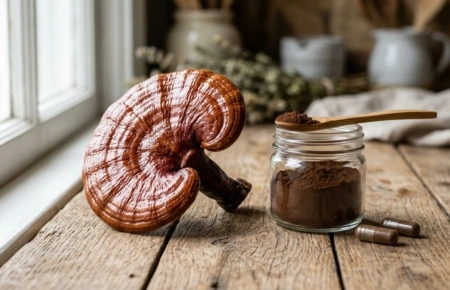
The mushroom has a distinctive appearance: a glossy, fan-shaped cap with a reddish-brown to dark mahogany surface. Wild reishi grows on decaying hardwood trees, though virtually all commercial supply today comes from cultivated sources. In wellness and supplement markets, it appears most commonly as an extract, powder, or capsule derived from the fruiting body or, in some products, the mycelium.
Key Bioactive Compounds in Reishi
Reishi contains a broad range of chemical constituents, but two groups stand out as its primary active components: polysaccharides (particularly beta-glucans) and triterpenoids (particularly ganoderic acids). Understanding what these compounds are helps clarify why researchers have investigated this mushroom across so many health areas.
Polysaccharides and Beta-Glucans
Beta-glucans are complex carbohydrates found in the cell walls of reishi. They are the same class of compounds studied in other functional mushrooms such as lion’s mane and turkey tail. In reishi, beta-glucan polysaccharides are the compounds most closely associated with immune-modulating effects — meaning they may influence how immune cells respond, rather than simply stimulating or suppressing immunity in a one-directional way.
Triterpenoids (Ganoderic Acids)
Reishi contains over 100 identified triterpenoids, collectively referred to as ganoderic acids. These bitter-tasting compounds are largely responsible for the mushroom’s anti-inflammatory and antioxidant activity. In laboratory and animal studies, ganoderic acids have also been linked to hepatoprotective (liver-protective) and renoprotective (kidney-protective) effects. These findings come primarily from in vitro and animal research and have not all been replicated in human trials.
Other Constituents
Beyond polysaccharides and triterpenoids, reishi contains phenolic compounds, fatty acids, sterols, peptides, vitamins, and minerals. These are present in smaller quantities and their individual contributions to the mushroom’s overall biological activity are less well characterized. Together, the full chemical profile of Ganoderma lucidum makes it one of the more studied functional mushrooms in both traditional and modern pharmacological research.
What Research Says About Reishi’s Health Benefits
The scientific literature on reishi spans decades and covers multiple health areas, but the quality of evidence varies considerably between topics. Some areas have human clinical data; others rest largely on laboratory or animal findings. The distinction matters for anyone evaluating a reishi mushroom supplement against marketed claims.
Immune Function
Immunomodulation is the most consistently studied property of reishi. Beta-glucan polysaccharides appear to interact with immune cell receptors, demonstrated across multiple in vitro and animal models. Human data exist but tend to come from small trials. The general picture is that reishi may support balanced immune activity, though it is not established as a treatment for any specific immune-related condition.
Lower Urinary Tract Symptoms (LUTS)
Among the cleaner areas of human clinical evidence for reishi is its use in men with lower urinary tract symptoms — the urinary difficulties often associated with benign prostatic conditions. Several clinical studies have reported symptomatic improvement with reishi supplementation in this population, making LUTS one of the better-supported applications in human trial data.
Blood Sugar and Dyslipidemia
Human studies have also reported mild antidiabetic effects and improvements in lipid profiles with reishi use. These effects appear modest and have been studied mostly in people with existing metabolic concerns. Reishi is not a substitute for prescribed diabetes or cardiovascular medications, and anyone managing these conditions with medication should be aware of potential interactions covered in the safety section below.
Anxiety
Some clinical work has noted reduced anxiety in individuals taking reishi, though this area is less developed than immune or metabolic research. The mechanism is not firmly established in humans, and this finding should be treated as preliminary rather than confirmed.
Cancer Adjunct Use
A 2016 Cochrane systematic review examined reishi as an adjunct to conventional cancer treatment. The review found that patients receiving reishi alongside chemotherapy or radiation therapy showed greater tumor regression and better quality-of-life outcomes compared to those receiving chemotherapy or radiation alone. However, reishi used alone showed no survival benefit — a limitation the Cochrane authors noted explicitly. Reishi is not a cancer treatment, and this data does not support using it as a standalone intervention for any cancer diagnosis.
Anti-Inflammatory and Antioxidant Effects
Anti-inflammatory and antioxidant properties are well-documented in preclinical research — that is, in cell-based and animal studies. These findings provide a biological rationale for many of reishi’s studied effects, but translating them into specific human clinical outcomes requires more robust trial evidence than currently exists for most indications.
Supplement Forms and How to Take Reishi
Reishi supplements come in several forms, each with practical differences in concentration, duration of safe use, and what to look for on the label. According to information compiled by Natural Medicines (via WebMD), adults have commonly used whole reishi mushroom powder at doses of 1,400–5,400 mg daily by mouth, typically divided across doses. Extract products are used at lower doses because they are more concentrated. These ranges are general reference figures — not personal dosing recommendations.
Duration of safe use also differs between forms. Reishi mushroom extract has been used in studies for up to approximately one year without reported serious adverse outcomes. Powdered whole mushroom has been studied for up to approximately 16 weeks. Using either form beyond these timeframes has less supporting safety data.
| Form | Typical Use Notes | Duration Consideration | Label Check |
|---|---|---|---|
| Capsules / Tablets | Convenient; dose is pre-measured per capsule | Depends on whether content is extract or whole powder | Check whether filling is extract or whole mushroom; look for beta-glucan percentage |
| Powdered Whole Mushroom | Added to drinks or food; flexible dosing | Up to ~16 weeks in available safety data | Look for fruiting body source; avoid undisclosed mycelium-on-grain products |
| Extract (liquid or dry) | More concentrated; lower volume needed | Up to ~1 year in available safety data | Check extract ratio (e.g., 10:1) or standardized compound percentage |
| Tea | Traditional preparation; mild potency | Variable; bioactive content not usually standardized | No reliable way to assess active compound content from tea alone |
| Tincture | Alcohol or water extraction; liquid dropper format | Depends on concentration; check product label | Look for dual extraction (water + alcohol) to capture both polysaccharides and triterpenoids |
Because supplement quality and active ingredient concentration vary widely across brands, standardized dosing is genuinely difficult to establish. Consult a healthcare provider before starting reishi, particularly if you take any medications or have an existing health condition.
Side Effects, Drug Interactions, and Who Should Avoid Reishi
Reishi is generally considered possibly safe for most healthy adults when used within studied timeframes and appropriate doses, but it is not without risk. Side effects and drug interactions are real and clinically relevant for certain groups.
Known Side Effects
Reported side effects from reishi use include:
- Dizziness
- Dry mouth
- Itching or skin rash
- Nausea
- Stomach upset
These tend to be mild and reversible, but their occurrence is a reason to start at lower doses and monitor your response, particularly with a new product or form.
Drug Interactions
Reishi interacts with several medication categories. If you take any of the following, discuss reishi use with your prescriber before starting:
- Anticoagulants and antiplatelet drugs (e.g., warfarin, aspirin, clopidogrel): Reishi may increase bleeding risk. Combining it with blood-thinning medications can amplify this effect.
- Blood pressure medications: Reishi may have an additive blood pressure-lowering effect, potentially increasing the risk of hypotension in people already on antihypertensive treatment.
- Immunosuppressants: Because reishi appears to modulate immune activity, it may work against medications designed to suppress the immune system — relevant for transplant recipients or people with autoimmune conditions on immunosuppressive therapy.
- Diabetes medications: Reishi’s mild blood sugar-lowering effects could compound the action of insulin or oral hypoglycemic agents, raising the risk of hypoglycemia.
Surgery Risk
Due to its effect on bleeding, reishi should be discontinued at least two weeks before any scheduled surgery. This applies regardless of whether you are taking anticoagulant medications — the mushroom itself carries this risk independently.
Pregnancy and Breastfeeding
Reishi is not recommended during pregnancy or breastfeeding. There is insufficient safety data to establish that it is safe for the developing fetus or for nursing infants, and the precautionary approach is to avoid it during these periods.
Other Populations to Be Cautious
People with bleeding disorders, low blood pressure, or compromised immune function — regardless of whether they are on related medications — should seek professional guidance rather than self-supplementing with reishi.
Choosing a Quality Reishi Supplement
Because reishi mushroom supplement quality varies considerably between products, label literacy is genuinely useful. Here are the practical markers worth checking before buying.
Fruiting Body vs. Mycelium
Most of the research on reishi has been conducted using the fruiting body — the actual mushroom cap and stalk — rather than mycelium (the root-like network). Some supplements are produced from mycelium grown on grain substrate, which may contain significant amounts of filler grain rather than fungal material. Labels that clearly state “fruiting body” or “fruiting body extract” are generally more aligned with the research context.
Extract Ratio and Standardization
An extract ratio (e.g., 10:1 or 20:1) indicates how much raw material was concentrated to produce the extract. A higher ratio means a more concentrated product, though ratio alone does not confirm potency without knowing the starting material quality. More informative is standardized beta-glucan content — a percentage listed on the label indicating the measured level of active polysaccharides. Products that disclose this figure allow for more meaningful comparisons across brands.
Third-Party Testing
Third-party testing by an independent laboratory confirms that the product contains what the label claims and is free from contaminants such as heavy metals, pesticides, and microbial impurities. Look for a certificate of analysis (COA) from a recognized testing body. Many quality-focused brands make COAs available on request or on their website.
Form Considerations
Tinctures produced by dual extraction (water and alcohol) are designed to capture both water-soluble polysaccharides and alcohol-soluble triterpenoids — both key compound groups. Single-extraction products may favor one class of compounds over the other. For powders added to food or drinks, check whether the source is fruiting body or mycelium, and whether any beta-glucan content is disclosed.
Given the wide variation in product quality across the Ganoderma lucidum supplement market, choosing a product that discloses its source material, provides third-party test results, and clearly labels active compound content puts you in a much stronger position than choosing based on price or packaging alone.